
What Is Modern Harmony? A Practical Introduction With Chord Examples
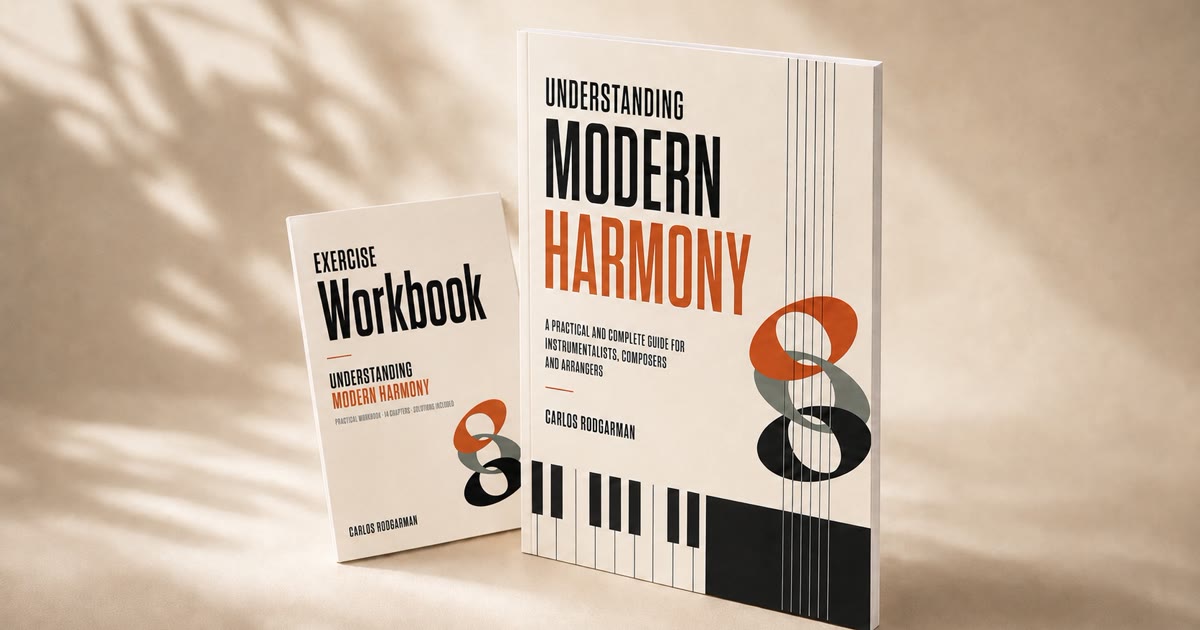
"Modern harmony" is one of those terms everybody uses and few people define. Students ask me about it after masterclasses, session players ask me about it in the studio, and it is the subject of my book, Understanding Modern Harmony. So here is the short, practical answer: what modern harmony is, the chords and ideas it is built on, with examples you can play right now, and the order in which I recommend learning it.
What is modern harmony?
Modern harmony is the harmonic language of the music most of us play today: pop, R&B, gospel, jazz, Latin music, film and TV scores. It grew out of classical tonal harmony, but it thinks differently about chords. Instead of triads and strict voice-leading rules, its basic unit is the four-note chord, every chord is related to a scale, and the colors that classical harmony treated as dissonances (the 9th, the 11th, the 13th) become part of the sound.
In practice, modern harmony answers three questions about any chord in a song: what it is made of, what job it does in the key, and which notes you can play over it. Once you can answer those three questions, you can analyze a song, write your own progressions, and reharmonize a melody with intention instead of by trial and error.
Modern harmony vs. classical harmony
They are not enemies. Modern harmony keeps the foundations of tonality: keys, intervals, cadences, the pull from dominant to tonic. What changes is the focus. Classical harmony is taught through four-part writing, triads and rules about how each voice moves. Modern harmony is taught through chord symbols (Dm7, G13, Cmaj9), chord-scale relationships and harmonic function, because that is how a rhythm section, an arranger or a producer actually works. A lead sheet with chord symbols is the everyday document of modern music.
The building blocks, with chord examples
All the examples are in C major so you can play them on any instrument. Try every one in all twelve keys afterwards: that is where the learning happens.
1. Seventh chords from the major scale
Stack thirds on each degree of the C major scale and you get the seven chords of the key:
- Imaj7 Cmaj7 (C E G B)
- IIm7 Dm7 (D F A C)
- IIIm7 Em7 (E G B D)
- IVmaj7 Fmaj7 (F A C E)
- V7 G7 (G B D F)
- VIm7 Am7 (A C E G)
- VIIm7(♭5) Bm7(♭5) (B D F A)
These seven chords are the raw material of an enormous number of songs.
2. Harmonic function: tonic, subdominant, dominant
Every chord does a job. Tonic chords (Cmaj7, Em7, Am7) feel like home. Subdominant chords (Dm7, Fmaj7) move away from home. Dominant chords (G7, Bm7(♭5)) create tension that wants to resolve. The heart of the dominant is the tritone between B and F: B wants to rise to C, F wants to fall to E. Thinking in functions is what lets you replace one chord with another without breaking the song.
3. Every chord has a scale
Each chord of the key comes with its own mode: Cmaj7 with C Ionian, Dm7 with D Dorian, Em7 with E Phrygian, Fmaj7 with F Lydian, G7 with G Mixolydian, Am7 with A Aeolian, Bm7(♭5) with B Locrian. This is how an improviser knows which notes work over each chord, and how an arranger chooses the notes for a horn line or a string pad.
4. Extensions and tensions: 9, 11, 13
Keep stacking thirds above the seventh and you reach the 9th, the 11th and the 13th. Cmaj9 is C E G B D. G13 adds E to G7, and in practice you voice it as G B F E, leaving out the 5th and usually the 11th. Not every extension works on every chord: an F (the 11th) over Cmaj7 rubs against the E of the chord and is usually avoided, while F♯ (the ♯11) sounds open and modern. Learning which tensions belong to which chord is a large part of modern harmony.
5. Secondary dominants
Any chord of the key can be preceded by its own dominant. In C major, A7 resolves to Dm7 (it is the V7 of II), E7 resolves to Am7 (the V7 of VI), D7 resolves to G7 (the V7 of V). A secondary dominant borrows a note from outside the key, C♯ in A7 for example, and gives the progression a stronger pull toward its target chord.
6. The II–V–I
Dm7 – G7 – Cmaj7 is the most important progression in modern harmony: subdominant, dominant, tonic. In minor, it becomes Dm7(♭5) – G7(♭9) – Cm7. Learn it in all twelve keys, major and minor, and you will start to see it everywhere, often moving from key to key inside a single song.
7. Tritone substitution
G7 and D♭7 share the same tritone (B and F, spelled C♭ and F in D♭7), so one can replace the other. Dm7 – D♭7 – Cmaj7 gives you a bass line that slides down by half steps toward the tonic. It is one of the first reharmonization tools most musicians learn, and one of the most useful.
8. Melodic minor and advanced scales
The modes of melodic minor open the door to the sounds of contemporary harmony. A♭ melodic minor (A♭ B♭ C♭ D♭ E♭ F G) is a good example. Started on G, it is the Altered scale for G7alt. Started on D♭, it is the Lydian Dominant scale for D♭7(♯11). Same notes, two dominants a tritone apart: tritone substitution again, seen from the scales. The diminished (symmetric) scale, the whole tone scale and the double harmonic scale belong to the same family of advanced colors.
9. Reharmonization, pedal bass and modulation
Once you control functions and substitutions, you can change the chords under a melody without changing the melody: that is reharmonization. A pedal bass keeps one bass note while the chords move above it, a classic device for intros and builds. And modulation takes a song to a new key, by a semitone, by a whole tone, by a fourth or to a mediant key. These are the tools that make an arrangement sound designed.
How to start learning modern harmony
The order matters more than the speed. This is the path I follow in the book:
- Keys, key signatures and intervals, until you recognize them by ear.
- Triads, seventh chords and the Greek modes.
- Diatonic harmonization and harmonic function.
- The minor key and cadences.
- Secondary dominants.
- Melodic minor, the Altered and Lydian Dominant scales, tritone substitution.
- II–V–I movements in all their forms.
- Reharmonization, pedal bass and modulation.
Do not just read it: play every concept in every key, write a short progression with each new idea, and listen for it in the songs you love. Harmony is understood with the hands and the ears, not only with the eyes.
Frequently asked questions
What is modern harmony in music?
It is the harmonic language of today's popular music, jazz and film scoring. It builds on classical tonal harmony, but uses four-note chords as the basic unit, relates every chord to a scale, and treats extensions such as the 9th, 11th and 13th as part of the sound.
What is the difference between modern and classical harmony?
Classical harmony is taught through triads, four-part writing and voice-leading rules. Modern harmony keeps the same tonal foundations but works with chord symbols, seventh chords, tensions, chord-scale relationships and harmonic function, which is how rhythm sections, arrangers and producers work today.
Can I teach myself modern harmony?
Yes, if you follow a clear order and practice every concept on your instrument in all twelve keys. A structured method with exercises helps you avoid the usual problem: plenty of scattered information and no sense of direction.
Is there a modern harmony book in PDF?
Yes. Understanding Modern Harmony is my complete method in 14 chapters, with a foreword by Humberto Gatica, available as a digital PDF and in paperback, with an optional Exercise Workbook of 161 exercises with solutions.
If this introduction made sense to you, the book goes all the way: from the major key and intervals to tonal complexes, artificial scales, every kind of II–V–I, reharmonization and modulation. Take a look at Understanding Modern Harmony, and if you read Spanish, the original edition is Entiende la Armonía Moderna.