Inside the Song

Dentro de "I Believe" de Paul Anka: cómo cobra vida el arreglo

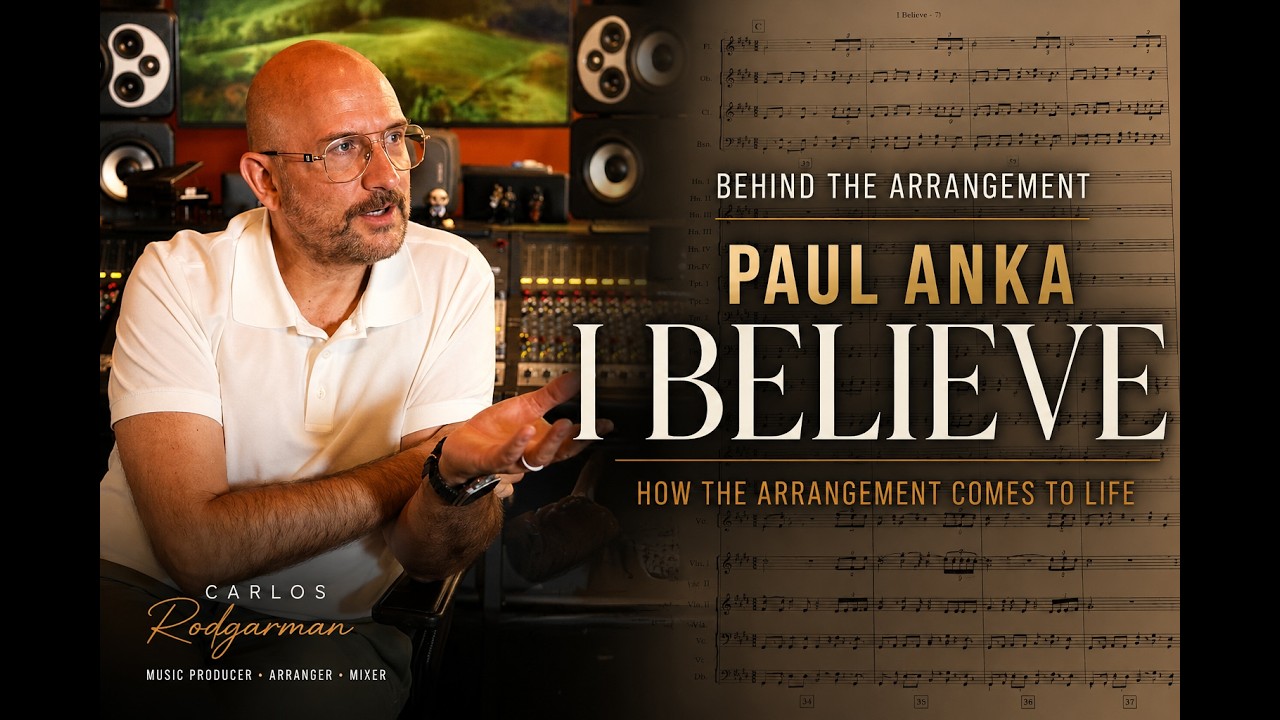
Casi todos estos análisis van de discos que mezclé. Este es distinto. "I Believe" es un disco que arreglé.

Paul Anka llevaba años queriendo hacer una versión nueva de esta canción, y mi buen amigo Jorge Vivo, que la produjo y la mezcló, también en Atmos, me llamó para escribir el arreglo. Así que aquí no estoy hurgando en la cinta de otro. Aquí te estoy enseñando lo que decidí y por qué.

Lo que Paul necesitaba era un momento de verdad épico en ese disco. Déjame enseñarte cómo intenté construírselo.

Todo empieza con un lápiz
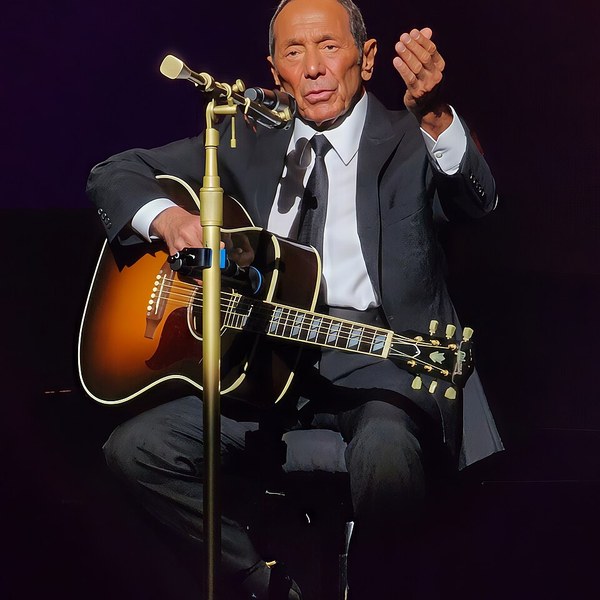
Paul Anka en el escenario en 2024
Paul Anka en el escenario en 2024. Foto: Crisco 1492, CC BY 4.0.

Antes de orquestar nada, antes de abrir nada en el ordenador, me siento y hago un boceto de la canción a mano. Melodía, estructura, qué es esto en realidad. Y lo escribo directamente en la tonalidad en la que voy a trabajar, no en la que llegó.

Suena a papeleo. Es el paso más importante que hay. Cuando tienes la canción entera en una hoja y en la tonalidad buena, por fin ves dónde está disponible la armonía: dónde puedes coger un acorde, cambiarlo, meter un segmento. Por debajo de todo esto, por cierto, la canción es un uno-seis-a-cinco de lo más corriente. Que sea corriente no es un problema. Que sea corriente es un lienzo.

Solo tienes tres mandos

La gente cree que un arreglista tiene opciones infinitas. La verdad es que no.

Tienes la orquestación: cuán grande, cuán densa, cuán simple. Tienes el tempo. Y tienes el voicing, que es el que todo el mundo olvida. El mismo acorde tocado cerrado y el mismo acorde tocado abierto son dos objetos emocionales completamente distintos. No has cambiado nada y lo has cambiado todo.

La introducción se la doy a la orquesta

La canción se llama "I Believe". Estaba pidiendo a gritos un vestido orquestal, así que decidí que la orquesta abriera la historia. La orquesta entera, desde el primer compás, antes de que Paul cante una nota.

Y luego escribí mapas de tempo, porque esto tiene que respirar. En este arreglo hay muchos cambios de tempo y todos son a propósito. La dinámica no es solo volumen y tamaño de orquesta. La dinámica también es cadencia. Si el tempo no se mueve nunca, la música no puede inhalar, y no tienes dónde darle sitio a un cantante para sus notas ni dónde preparar un ritardando antes de una frase que importa.

La parte de piano se la di a un arpa

Esta decisión me gusta especialmente. Escribí el acompañamiento íntimo como una parte de piano, y luego se la pasé al arpa.

La canción tenía que bajar hasta una conversación privada antes de poder explotar más tarde, y sobre este material el arpa lo hace mejor. Menos peso, más aire, y ningún ataque percusivo cayendo debajo de cada sílaba. En la introducción el arpa es la que lleva el tiempo. Las maderas se mueven por debajo. Esa es toda la producción que hay detrás de Paul en ese momento.

Él cantó precioso en esa sección y, sinceramente, el trabajo del arreglo ahí es ser lo bastante pequeño como para que se le oiga pensar.

Crece, quítalo, vuelve
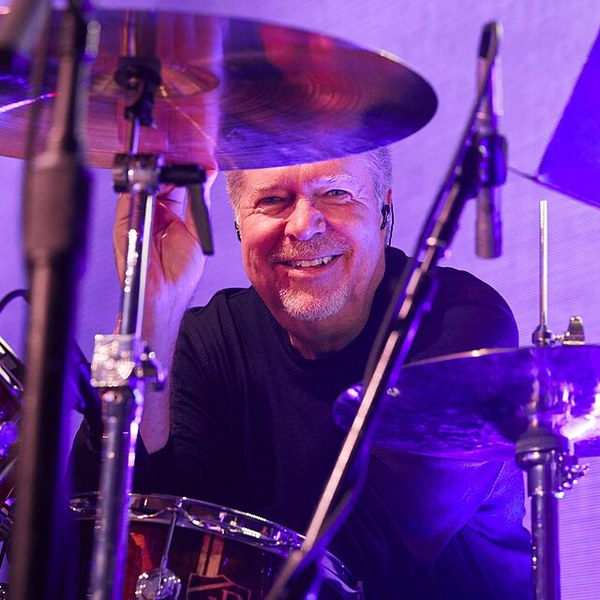
Retrato de JR Robinson a la batería
JR Robinson, que también toca en I Can't Help It. Foto: Suzanne Teresa, CC BY-SA 4.0.

La primera mitad no es una rampa. Crece un poco, luego devuelve algo, luego vuelve. Ese repliegue es la respiración. Y es también lo que hace que la llegada se sienta ganada en vez de programada.

La sección rítmica no aparece hasta la mitad de la canción. Toda la primera mitad es Paul y la orquesta sosteniendo la historia, y nada más. Así que cuando la batería y el bajo aterrizan por fin en la segunda estrofa, aterrizan como un acontecimiento, porque llevas dos minutos esperándolos sin saberlo. Son JR Robinson a la batería y Oskar Cartaya al bajo, y en cuanto entran estás escuchando otro tipo de disco.

El turnaround que no puedo dejar en paz

Al volver a la segunda estrofa hay una línea que me encanta, y voy a confesar una cosa: tengo debilidad por la novena bemol. A estas alturas ya lo habrás notado.

Lo que hago aquí es un acorde suspendido con una novena bemol. Piensa por qué funciona. Un acorde sus está sin resolver por definición, así que te mantiene sin pisar el suelo. La novena bemol encima es dulce, no áspera. Juntas te dan tensión y dulzura dentro del mismo acorde: la armonía se niega a asentarse, y mientras se niega no duele. Esa combinación es el registro emocional de toda la canción en un solo voicing.

Un acorde de La bemol séptima suspendido y el mismo acorde con la novena bemol añadida encima el acorde sus A 7 sus 4 con la novena bemol A 7 sus 4 ♭9
El acorde sus te mantiene sin pisar el suelo. La novena bemol encima pone la dulzura. Las dos a la vez, y la armonía puede negarse a asentarse sin que duela.

Cada línea tiene que tener vida propia

Cuando los elementos empiezan a entrar, lo fácil es escribir bloques. Un muro de cuerdas creciendo detrás del cantante. Yo me esfuerzo mucho en no hacer eso.

Si los violines tocan una línea que apoya a Paul o le responde, entonces hay una línea de violonchelo respondiendo a los violines. Todo se mueve y se habla, mucho más cerca de cómo se comporta una partitura clásica que de un pad de cuerdas pop. De ahí sale la fluidez. La historia no solo sube de volumen, va pasando de voz en voz. Eso es lo que hace un arreglo cinematográfico en el sentido de verdad, no en el sentido de «alto».

Lydio, y cómo levanta el final

El puente es el gran momento orquestal. Hay mucho lydio en esta canción y está puesto a propósito, por esa cualidad suspendida, abierta y cinematográfica que solo te da el lydio.

Y luego la modulación la hace la propia orquesta. Estamos en Re bemol y nos vamos a Re mayor para el final. Las maderas escriben contracantos a través del cambio, los metales entran con ellas, las cuerdas se llevan la melodía principal.

Y ahora la parte difícil, que es Paul. Tiene que volver a entrar, en la tonalidad nueva, después de todo eso. Su interpretación ya está levantando. Pero yo acabo de expandir la armonía en todas las direcciones, y si la dejo expandida él entra en un lío.

Así que hago lo contrario de lo que el momento parece pedir. Lo colapso todo a unísonos y octavas sobre el leitmotiv. Después de todos esos contracantos y de todo ese movimiento, el unísono golpea como un puñetazo. El mayor impulso de la canción está hecho de resta.

Y entonces paro la orquesta

Paul todavía tiene que entregar su último "I believe". La money note, como la llamamos.

Bajo toda la orquestación a un trémolo, y luego paro el trémolo también. Silencio, y después él. No hay nada que puedas escribir que compita con quitarlo todo.

Para el último acorde lo convierto en lydio, para que el arpa pueda pasear glissandos por encima de esa oncena aumentada. Color cinematográfico una vez más, y es lo último que se oye.

Lo que yo te diría

A veces la mejor decisión de arreglo es apartarse de en medio de todo.

Desnúdalo para que más tarde tengas hacia dónde explotar. Construye la dinámica con los cuatro mandos, tamaño de orquesta y volumen e intensidad y tempo, en vez de ir directo al fader. Dale vida propia a cada línea, para que la partitura converse en lugar de limitarse a hincharse. Y cuando por fin llegue el momento más grande, acuérdate de que tienes disponible el unísono, y también el silencio.

Un momento épico no es nunca el compás más alto de la canción. Es el compás para el que pasaste tres minutos despejando sitio.

Transcripción completa (en inglés)
  1. 0:00 Hi, Carlos Rodgarman here. I want to show you how do we go from this...
  2. 0:13 ...to this.
  3. 0:30 I believe, I believe, I believe.
  4. 0:54 In this episode I'm going to show you a little bit inside of my arrangement of the song I believe for Paul Anka.
  5. 1:00 And how I designed a little bit the dynamics of the song with the tempo, with the orchestration and how to have Paul have this epic moment in the album that I thought it was very needed.
  6. 1:11 I was very lucky to be invited in this project by my dear friend Jorge Vivo who produced and mixed actually this and he mixed it in Atmos as well, this project is also in Atmos.
  7. 1:20 So this is a song that has been I guess one of Paul's favorites for many years and he wanted to do a new take on it.
  8. 1:28 So when we met and he showed me the song, first thing obviously is to find his key, this tempo, what's going to work.
  9. 1:37 But then I felt like this could be really especially being called I believe, right?
  10. 1:41 He was crying to have this epic moment, this support, this orchestral dressing.
  11. 1:48 This is kind of like a little bit inside of how I designed this for Paul Anka.
  12. 1:52 First obviously you have to start with just listening to the song, what is the melody, the structure, write it down.
  13. 1:59 Usually this is my first step, I just by pencil go writing down a basic sketch.
  14. 2:06 I write it already in the key that I'm going to be working on.
  15. 2:09 Once I do that, I can understand what moments I can grab the harmony, change, substitute, add a segment.
  16. 2:18 It's a very standard one six to five kind of movement.
  17. 2:26 So this is where you as an arranger, you have to decide, you have different tools.
  18. 2:31 Like we said, it's like the orchestration, how big or dense or simple, the tempo.
  19. 2:36 But also it changes if you play things open, close, you know, voicings.
  20. 2:42 So that's very different to play than to play very open.
  21. 2:54 First of all, it's like how do we make this dynamic, right?
  22. 2:56 Since I wanted to bring in the orchestra and have it be, you know, that kind of moment,
  23. 3:01 I figured that I wanted the orchestra to actually open up the story, right?
  24. 3:04 So you guys can see how I have the whole orchestra here in the intro.
  25. 3:09 Very important in the music to breathe and especially when you're bringing this type of songs
  26. 3:13 that have strings and all that, it's doing your tempo maps.
  27. 3:16 You can see guys here all these tempo changes.
  28. 3:19 That is going to allow for the music to breathe, to have that dynamic,
  29. 3:23 not only in the volume and size of the orchestration, but also in the music itself, the cadence.
  30. 3:30 You want to give Paul his moments for his notes and etc.
  31. 3:33 So in the intro, I decided to give it to the orchestra.
  32. 3:37 Let me play you a little bit of the orchestra so you can see the intro of the orchestra.
  33. 4:07 Very key element.
  34. 4:12 I decided that for this, I wanted to change and especially being, I believe,
  35. 4:17 I wanted to really be intimate and break it down all the way to give Paul that
  36. 4:22 very intimate personal conversation kind of tone until we explode later.
  37. 4:27 So for that, I figured in this song, actually, I liked harp better than piano.
  38. 4:31 So I designed the part that I wanted in the piano, but then I had the harp
  39. 4:36 play that part.
  40. 4:38 Actually, the harp is what keeps up the time in the intro, as you can see.
  41. 4:52 I have the woodwinds doing a little bit of movement as well.
  42. 5:11 That's one of the moments where I'm doing like we've shown in the past.
  43. 5:15 You grow a little bit, you take it away, and then you come back again.
  44. 5:18 That breath, you can see, let me play you from the master.
  45. 5:36 And then we fall down, like I said, to a very intimate conversational.
  46. 5:40 He did an incredible performance here, Paul.
  47. 5:42 So listen to the harp instead of the piano, how it's with him together.
  48. 5:47 Very intimate.
  49. 6:03 Then obviously, I start to introduce the orchestra to start to grow it a little bit.
  50. 6:07 Pretty much the rhythm section starts kind of like from the middle to the end.
  51. 6:10 This whole first half, it's just the story.
  52. 6:13 It's Paul, and it's the orchestra supporting all that.
  53. 6:16 I can show you a little bit, for example, some of the strings on this, the second half of the verse.
  54. 6:42 The same way, I start with the strings,
  55. 6:44 but then I start to bring in little by little some of the other elements.
  56. 6:48 Like you see, I break the wound winds here.
  57. 7:03 And we finally land on the second verse, where the drums bass are going to come in.
  58. 7:09 We actually had JR on drums and a Skarkertai on bass.
  59. 7:12 I'll play you a little bit of the groove second verse.
  60. 7:14 One of my favorite tenor rounds, I'm a sucker for the flat nine, as probably you already heard.
  61. 7:31 But when we're coming from here, back to the second verse,
  62. 7:37 I love this line where I do the sass, but with the flat nine.
  63. 7:44 Right, so you get a little bit more of that tension of the sass that doesn't resolve with the sweetness of the flat nine.
  64. 8:09 With the vocals.
  65. 8:14 So the secret to this is to keep it moving, where he's evolving the story as he sings.
  66. 8:35 So with the orchestra, we started kind of like medium to big.
  67. 8:39 We break it down to a very intimate and then we start to bring in the elements.
  68. 8:42 Those elements that we bring need to have a life of their own.
  69. 8:46 So meaning, like if I have violins doing a line that supports him or answers him,
  70. 8:51 there's going to be a cello line that maybe answers to those violins.
  71. 8:54 So everything is not just a block of strings, but everything's kind of more in a classical way,
  72. 9:00 a little bit moving and talking to each other.
  73. 9:02 That's how you get this fluidity of the story.
  74. 9:05 The arrangement is more cinematic, so to speak.
  75. 9:08 On the bridge, the big orchestra moment.
  76. 9:10 That's when I go to this epic, I use a lot of the Lydian in this song,
  77. 9:15 just to create that cinematic feel.
  78. 9:40 Did you see how I did that modulation?
  79. 9:42 Now we're in D.
  80. 9:43 This is the instrumental part.
  81. 10:10 So, as you can see, in the orchestra, we start big.
  82. 10:20 And the orchestra is actually doing that modulation.
  83. 10:23 We're in D flat.
  84. 10:24 We're going to D major now for the ending.
  85. 10:26 I'll show you how the woodwinds are doing the counterparts on that.
  86. 10:41 Together with the brass section, right?
  87. 10:50 Together, woodwinds and brass.
  88. 11:02 And obviously the strings are doing the main melody.
  89. 11:10 Now, one of the things I tried to do with this,
  90. 11:24 after we have the orchestra exploding,
  91. 11:26 now he's going to come in on the new key.
  92. 11:28 So, it has to even be bigger.
  93. 11:29 Obviously, his performance is already lifting compared to the orchestra.
  94. 11:33 But then, after all these counter lines, all this movement,
  95. 11:38 all this orchestra, the harmonies are expanded.
  96. 11:41 The best way that I can do it, kind of like this epic lift,
  97. 11:44 when he comes in, I'm going to go to unison and octaves on this late motif.
  98. 11:49 Listen to this with the vocal.
  99. 12:06 After this, we have to give Paul his moment for his money note, like we call it.
  100. 12:12 So, I stop the whole orchestration into a tremolo.
  101. 12:16 Stop everything, silence for him to deliver his very last "I believe".
  102. 12:20 Listen to that.
  103. 12:36 And for all the harmony nerds out there, obviously for the very end,
  104. 12:46 I changed the chord into a Lydian so I can have that cinematic vibe on the harp.
  105. 12:51 There's doing the glissandos with that sharp 11.
  106. 12:54 Look at that.
  107. 13:04 Sometimes, the best arrangement choice is to not be on the way of anything.
  108. 13:08 So, sometimes it's just like stripping everything down,
  109. 13:11 or creating that space so that later you can explode into something bigger,
  110. 13:15 and then you create those dynamics.
  111. 13:17 Again, those dynamics are going to be not only the orchestration size,
  112. 13:21 the volume, the intensity, but also the tempo.
  113. 13:24 Tempo is also going to play a part of it,
  114. 13:26 like how you can prepare his ritardandos before any notes.
  115. 13:30 The next episode, I'm going to bring some other songs and arrangements
  116. 13:33 that I've been involved with. Thanks for watching and remember to like and subscribe!