
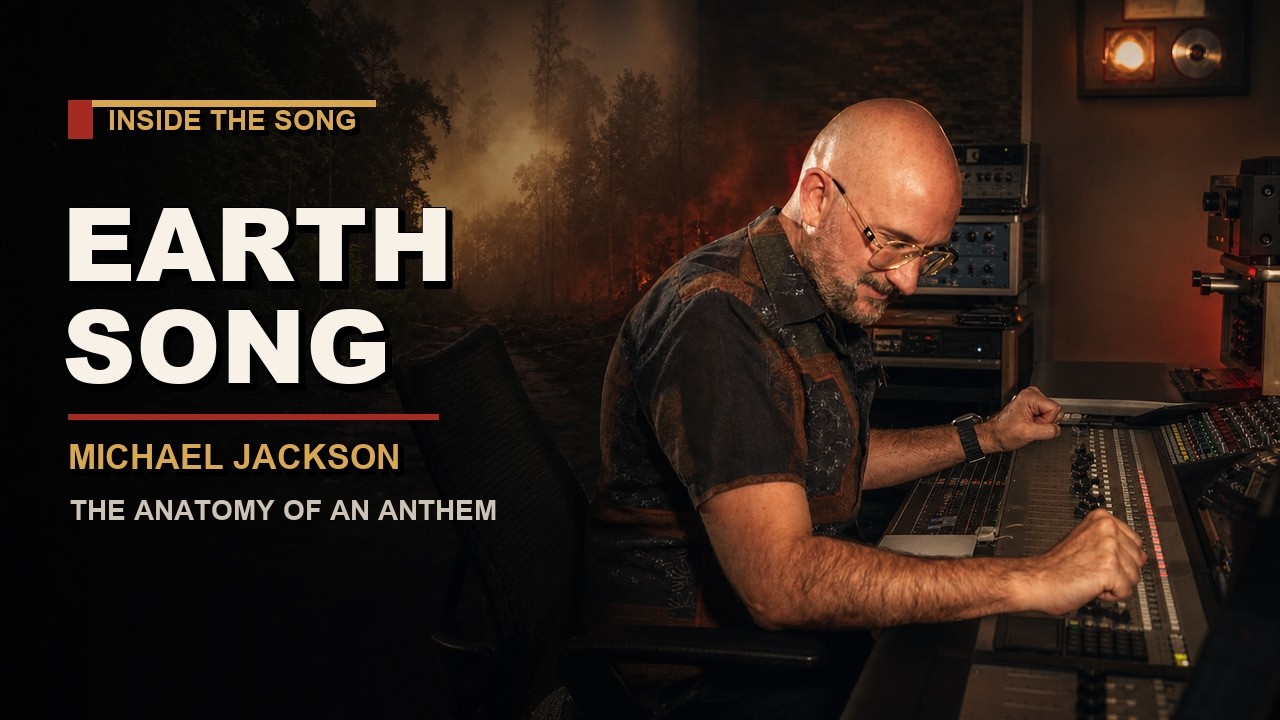
How does a pop song end up with the magnitude of a film?
"Earth Song", from HIStory, is the record where that question has a real answer. I had the privilege of mixing it in Dolby Atmos with Humberto Gatica, and opening these multitracks you find out that it isn't a big chorus with a big arrangement behind it. It's architecture. Every element arrives at the exact moment the story needs it, and not one of them arrives early.
It also asks a question that is still current, unfortunately, and I have a feeling it's going to stay current for some time. So let's look at how Michael made the Earth the main character of the movie.
A song that took seven years to arrive
He wrote it in a hotel room in Vienna, on the first of June 1988, in the middle of the Bad tour. There are demos of that early version floating around. It didn't come out until 1995, on HIStory, seven years later.
The video, directed by Nick Brandt, made as much of an impact as the record did, and it tells the story backwards. It opens on the destruction, on everything we've done to the planet, and as the song grows it moves into the healing, until nature is restored. The music does the same thing in the same order, and that is the whole point.
It shares a shape with the Man in the Mirror breakdown: a very intimate beginning that ends in an explosion of choir, the world singing together. What changes is how it gets there.
The harmony stays simple on purpose
We're in A flat minor. The piano motif comes in first, and it carries the harmonic idea of the whole verse before Michael has sung a note.
Here's the trick: harmonically the song stays simple, and all the complexity goes into the layers and the orchestration as it grows. But there's always a little something inside that simplicity. We go one to four, and the four is major, not minor. In a minor key the fourth degree should be minor. This one isn't.
That's a Dorian parallel: the same chord with its third raised, which opens the colour up without leaving the key. Then it goes to the five, and the five is embedded in the riff itself. Three chords. That's the harmonic engine of a record that ends up sounding like a film score.
The first verse gives you nothing to hold on to
Michael, and a piano. That's it.
The performance is completely stripped down, and it has to be, because what the verse is describing is the brokenness of the world. He shows the emotion and the arrangement gets out of the way. Nothing holds the floor up, so you lean in.
Then the pre-chorus makes its move. It goes to the four again, but this time to the minor one, the one that actually belongs to the key. And leaning on that chord, the song touches the relative major for a second. A window opens, light comes in, and it closes again. The whole harmonic argument of the song is right there: the same degree, told two different ways.
The first chorus still has no drums
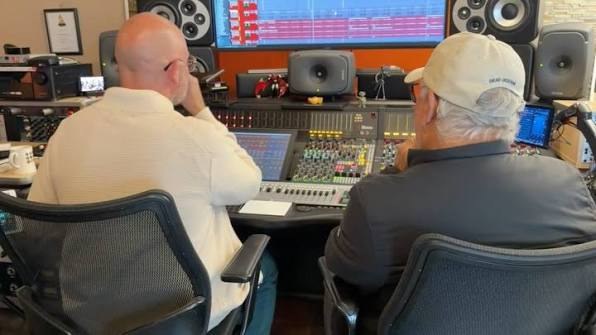
The main line arrives, the one everybody remembers, and there are still no drums. There's the bass, and there's a tambourine, which in Atmos I placed slightly elevated, above the plane of everything else.
That single decision changes the room. The keyboards and the pads are already building landscapes that move from the shoulders to the front, and lifting the tambourine out of that plane gives the chorus height before it has any weight. Michael stays in front. Always in front, in every section, no matter how big it gets around him.
The guitar answers him
The second verse brings in a new guest: the guitar. You've heard that line a million times without ever separating it from the record, and what it's doing is answering Michael, phrase for phrase, in the gaps he leaves. It isn't accompaniment. It's a second voice in the conversation, and it brings a new colour into a song that so far has only had piano and pads.
Later, in the choruses, another guitar comes in strumming, and almost nobody notices it. It isn't playing harmony. It's keeping time. It behaves like percussion in a section that, at that point, still doesn't have enough of it.
The orchestra you've never really heard

Here's the gem. Behind everything, there is a full orchestral arrangement that is spectacular, and it's tucked so far into the mix that most people have never consciously heard it.
That's how David Foster and Bill Bottrell designed it with Michael, and it works: the strings aren't there to be admired, they're there to push. Solo them and you hear a piece of writing that would carry a film. Put them back and you don't hear strings at all. You just feel the song getting bigger.
Separating those elements is the argument for doing this work in immersive. Not spectacle. Recovering musical information that was on the tape the whole time.
His foot on the floor

Solo Michael right before the chorus where the drums come in, and you catch something that isn't in any arrangement sheet: his foot on the floor, on the clap, setting up the entrance.
He's counting the band in with his body, and it stayed on the tape. That's the record telling you the drums are about to arrive one bar before they do.
And they arrive properly. Steve Ferrone played them, and the story of how they got there is worth knowing: Michael wanted electronic drums, Ferrone made a deal to cut one demo each way, and when the acoustic version came back Michael started dancing across the room. He was right to. Those drums are half the scale of everything that comes after them.
The bridge goes down, not up
A song this size is expected to keep climbing. This one does the opposite.
For the bridge the energy comes down: piano and strings, holding the whole thing on very little. And behind it there's a sampled synth choir pad, a voice texture that isn't singing anything, sitting there to keep the space warm while the arrangement empties out.
It's the same lesson as the intro. If you want the ending to feel enormous, you have to be willing to give up the floor one more time before you get there.
One whole step up
The best way to elevate a song is still the oldest one. Key change.
Straight up a whole step, direct, no preparation, into B flat minor. No pivot chord, no ramp: the song simply stands somewhere higher and keeps going. It's regularly voted one of the great key changes in pop, and the reason it works is everything that came before it. Five minutes of restraint is what buys you a whole step.
And on the way out, the turnaround changes too. Instead of just sitting on the five the way it did all song, it does something else on the way back. Small detail. It's what keeps the ending from feeling like a loop.
The choir, and the octave underneath
The choir is Andraé Crouch's, and what he and Michael are doing in the climax is call and response. He shouts, they answer. He shouts again, they answer again. Nobody is singing a part: two forces are talking to each other, and that's why the ending sounds like a crowd instead of a production.
Underneath all of it, the bass has a sub-octave mixed in, so every note is doubled an octave lower than you think you're hearing. Guy Pratt played it, and that low octave is what keeps a section this loud from turning thin.
Listen to Michael's delivery across the whole record. He started as intimately as it's possible to start. By this point he's screaming, and it doesn't sound like effort. It sounds like conviction, which is a much harder thing to record.
It ends on a question
Now, this part is my personal interpretation.
The song ends on the dominant chord, without resolving. It hangs there, up in the air, and the record stops.
For me that's the whole song saying one last thing: this is an open question. How do we resolve it? It's up to us. Musically it's genius, because the harmony refuses to give you the comfort the arrangement has spent the whole record building. You don't get closure. You get homework.
What to take from it
Magnitude isn't volume, and it isn't more instruments.
It's a simple harmony you can trust, a mode borrowed for one chord so the simple thing never gets boring, and an arrangement that adds one element at a time in the exact order the story needs. It's an orchestra willing to be invisible, a drummer willing to be argued with, and a singer whose foot on the floor made the final mix.
And it's the confidence to end on a chord that doesn't resolve, because the question the song is asking hasn't been resolved either.