Inside the Song

Inside Paul Anka's "I Believe": How the Arrangement Comes to Life

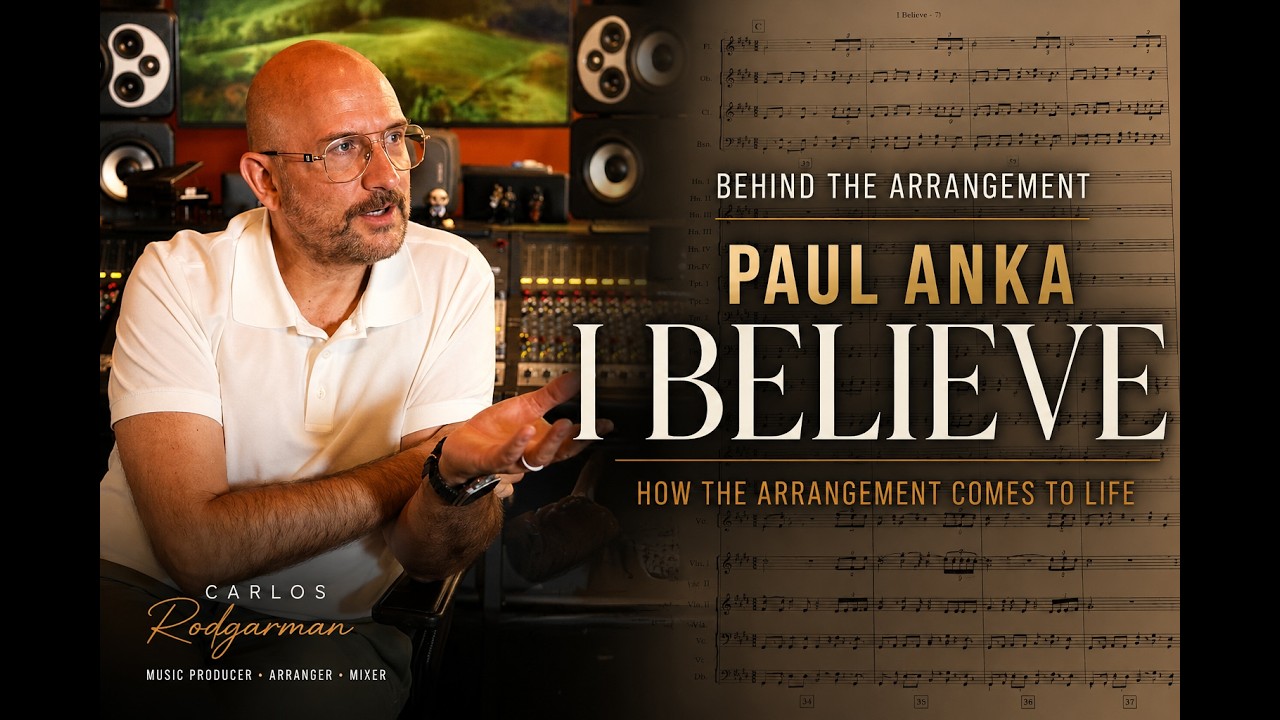
Most of these breakdowns are about records I mixed. This one is different. "I Believe" is a record I arranged.

Paul Anka had wanted to do a new take on this song for years, and my dear friend Jorge Vivo, who produced it and mixed it, in Atmos too, brought me in to write the arrangement. So this isn't me digging through somebody else's tape. This is me showing you what I decided and why.

What Paul needed was one genuinely epic moment on that album. Let me show you how I tried to build him one.

Everything starts with a pencil
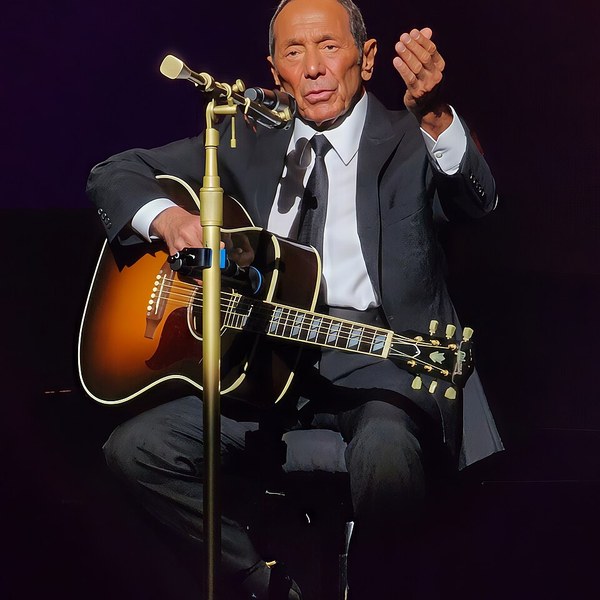
Paul Anka on stage in 2024
Paul Anka on stage in 2024. Photo: Crisco 1492, CC BY 4.0.

Before any orchestration, before I open anything on a computer, I sit down and sketch the song by hand. Melody, structure, what the thing actually is. And I write it straight into the key I'm going to work in, not the key it arrived in.

That sounds like paperwork. It's the most important step there's. Once the whole song is on one page in the right key, you can finally see where the harmony is available: where you can grab a chord, swap it, stick a segment in. Underneath all of this, by the way, the song is a completely ordinary one-six-to-five. Ordinary isn't a problem. Ordinary is a canvas.

You only have three dials

People think an arranger has infinite options. You really don't.

You have orchestration: how big, how dense, how simple. You have tempo. And you've voicing, which is the one everybody forgets. The same chord played close and the same chord played open are two completely different emotional objects. You changed nothing and you changed everything.

Give the intro to the orchestra

The song is called "I Believe". It was crying out for an orchestral dressing, so I decided the orchestra opens the story. The whole orchestra, right at the top, before Paul sings a note.

And then I wrote tempo maps, because the thing has to breathe. There are a lot of tempo changes in this arrangement and every one of them is deliberate. Dynamics aren't just volume and orchestra size. Dynamics are also cadence. If the tempo never moves, the music can't inhale, and you've nowhere to give a singer room for his notes or to set up a ritardando before a line that matters.

I gave the piano part to a harp

Here's a decision I'm fond of. I wrote the intimate accompaniment as a piano part, and then handed it to the harp.

The song had to come all the way down to a private conversation before it could explode later, and on this material the harp does that better. Less weight, more air, and no percussive attack landing under every syllable. In the intro the harp is what carries the time. Woodwinds move underneath it. That's the entire production behind Paul at that point.

He sang beautifully in that section, and honestly the job of the arrangement there's to be small enough that you can hear him thinking.

Grow, take it away, come back
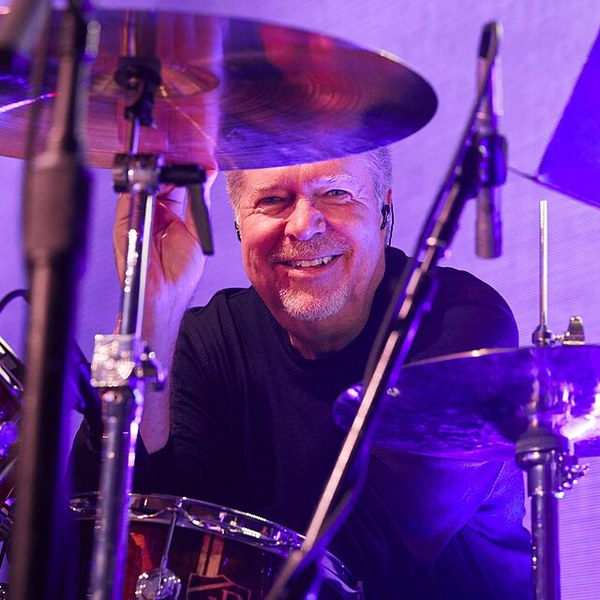
Portrait of JR Robinson at the drums
JR Robinson, who also plays on I Can't Help It. Photo: Suzanne Teresa, CC BY-SA 4.0.

The first half isn't a ramp. It grows a bit, then it gives something back, then it returns. That retreat is the breath. It's also what makes the arrival feel earned instead of scheduled.

The rhythm section doesn't turn up until around the middle of the song. The whole first half is Paul and the orchestra holding the story, and nothing else. So when the drums and bass finally land on the second verse, they land as an event, because you've been waiting two minutes for them without knowing it. That's JR Robinson on drums and Oskar Cartaya on bass, and the moment they arrive you're listening to a different kind of record.

The turnaround I can't leave alone

Coming back into the second verse there's a line I love, and I'm going to admit something: I'm a sucker for the flat nine. You have probably worked that out by now.

What I do here's a suspended chord carrying a flat nine. Think about why that works. A sus chord is unresolved by definition, so it holds you off the ground. The flat nine sitting on top of it's sweet, not harsh. Together you get tension and sweetness inside the same chord: the harmony refuses to settle, and it doesn't hurt while it refuses. That combination is the emotional register of this whole song in one voicing.

An A flat seventh suspended chord and the same chord with a flat ninth added on top the sus chord A 7 sus 4 with the flat ninth A 7 sus 4 ♭9
A sus chord holds you off the ground. The flat ninth on top adds the sweetness. Both at once, and the harmony can refuse to settle without it hurting.

Every line has to have its own life

When the elements start coming in, the easy thing is to write blocks. A wall of strings swelling behind the singer. I try very hard not to do that.

If the violins play a line that supports Paul or answers him, then there's a cello line answering the violins. Everything is moving and talking to each other, much closer to how a classical score behaves than to a pop string pad. That's where the fluidity comes from. The story doesn't just get louder, it keeps getting handed from voice to voice. That's what makes an arrangement cinematic in the real sense, not the loud sense.

Lydian, and how the ending lifts

The bridge is the big orchestral moment. There's a lot of Lydian in this song and it's there on purpose, for that suspended, wide-open, cinematic quality only Lydian gives you.

Then the orchestra does the modulation itself. We're in D flat and we go to D major for the ending. The woodwinds write counterparts through the change, the brass comes in with them, the strings take the main melody.

And now the hard part, which is Paul. He has to come back in, in the new key, after all of that. His performance is already lifting. But I have just expanded the harmony in every direction, and if I leave it expanded he walks into a mess.

So I do the opposite of what the moment looks like it wants. I collapse everything down to unison and octaves on the leitmotif. After all those counter-lines and all that movement, unison hits like a fist. The biggest lift in the song is made of subtraction.

Then I stop the orchestra

Paul still has to deliver his last "I believe". The money note, as we call it.

I take the whole orchestration down into a tremolo, and then I stop the tremolo too. Silence, and then him. There's nothing you can write that competes with taking everything away.

For the very last chord I turn it into a Lydian so the harp can run glissandos across that sharp eleventh. Cinematic colour one more time, and it's the last thing you hear.

What I would tell you

Sometimes the best arranging decision is to get out of the way of everything.

Strip it down so that later you've somewhere to explode into. Build your dynamics out of all four dials, orchestration size and volume and intensity and tempo, instead of reaching straight for the fader. Give every line its own life so the score has a conversation instead of just swelling. And when the biggest moment finally arrives, remember that unison is available to you, and so is silence.

An epic moment is never the loudest bar in the song. It's the bar you spent three minutes clearing space for.

Full transcript
  1. 0:00 Hi, Carlos Rodgarman here. I want to show you how do we go from this...
  2. 0:13 ...to this.
  3. 0:30 I believe, I believe, I believe.
  4. 0:54 In this episode I'm going to show you a little bit inside of my arrangement of the song I believe for Paul Anka.
  5. 1:00 And how I designed a little bit the dynamics of the song with the tempo, with the orchestration and how to have Paul have this epic moment in the album that I thought it was very needed.
  6. 1:11 I was very lucky to be invited in this project by my dear friend Jorge Vivo who produced and mixed actually this and he mixed it in Atmos as well, this project is also in Atmos.
  7. 1:20 So this is a song that has been I guess one of Paul's favorites for many years and he wanted to do a new take on it.
  8. 1:28 So when we met and he showed me the song, first thing obviously is to find his key, this tempo, what's going to work.
  9. 1:37 But then I felt like this could be really especially being called I believe, right?
  10. 1:41 He was crying to have this epic moment, this support, this orchestral dressing.
  11. 1:48 This is kind of like a little bit inside of how I designed this for Paul Anka.
  12. 1:52 First obviously you have to start with just listening to the song, what is the melody, the structure, write it down.
  13. 1:59 Usually this is my first step, I just by pencil go writing down a basic sketch.
  14. 2:06 I write it already in the key that I'm going to be working on.
  15. 2:09 Once I do that, I can understand what moments I can grab the harmony, change, substitute, add a segment.
  16. 2:18 It's a very standard one six to five kind of movement.
  17. 2:26 So this is where you as an arranger, you have to decide, you have different tools.
  18. 2:31 Like we said, it's like the orchestration, how big or dense or simple, the tempo.
  19. 2:36 But also it changes if you play things open, close, you know, voicings.
  20. 2:42 So that's very different to play than to play very open.
  21. 2:54 First of all, it's like how do we make this dynamic, right?
  22. 2:56 Since I wanted to bring in the orchestra and have it be, you know, that kind of moment,
  23. 3:01 I figured that I wanted the orchestra to actually open up the story, right?
  24. 3:04 So you guys can see how I have the whole orchestra here in the intro.
  25. 3:09 Very important in the music to breathe and especially when you're bringing this type of songs
  26. 3:13 that have strings and all that, it's doing your tempo maps.
  27. 3:16 You can see guys here all these tempo changes.
  28. 3:19 That is going to allow for the music to breathe, to have that dynamic,
  29. 3:23 not only in the volume and size of the orchestration, but also in the music itself, the cadence.
  30. 3:30 You want to give Paul his moments for his notes and etc.
  31. 3:33 So in the intro, I decided to give it to the orchestra.
  32. 3:37 Let me play you a little bit of the orchestra so you can see the intro of the orchestra.
  33. 4:07 Very key element.
  34. 4:12 I decided that for this, I wanted to change and especially being, I believe,
  35. 4:17 I wanted to really be intimate and break it down all the way to give Paul that
  36. 4:22 very intimate personal conversation kind of tone until we explode later.
  37. 4:27 So for that, I figured in this song, actually, I liked harp better than piano.
  38. 4:31 So I designed the part that I wanted in the piano, but then I had the harp
  39. 4:36 play that part.
  40. 4:38 Actually, the harp is what keeps up the time in the intro, as you can see.
  41. 4:52 I have the woodwinds doing a little bit of movement as well.
  42. 5:11 That's one of the moments where I'm doing like we've shown in the past.
  43. 5:15 You grow a little bit, you take it away, and then you come back again.
  44. 5:18 That breath, you can see, let me play you from the master.
  45. 5:36 And then we fall down, like I said, to a very intimate conversational.
  46. 5:40 He did an incredible performance here, Paul.
  47. 5:42 So listen to the harp instead of the piano, how it's with him together.
  48. 5:47 Very intimate.
  49. 6:03 Then obviously, I start to introduce the orchestra to start to grow it a little bit.
  50. 6:07 Pretty much the rhythm section starts kind of like from the middle to the end.
  51. 6:10 This whole first half, it's just the story.
  52. 6:13 It's Paul, and it's the orchestra supporting all that.
  53. 6:16 I can show you a little bit, for example, some of the strings on this, the second half of the verse.
  54. 6:42 The same way, I start with the strings,
  55. 6:44 but then I start to bring in little by little some of the other elements.
  56. 6:48 Like you see, I break the wound winds here.
  57. 7:03 And we finally land on the second verse, where the drums bass are going to come in.
  58. 7:09 We actually had JR on drums and a Skarkertai on bass.
  59. 7:12 I'll play you a little bit of the groove second verse.
  60. 7:14 One of my favorite tenor rounds, I'm a sucker for the flat nine, as probably you already heard.
  61. 7:31 But when we're coming from here, back to the second verse,
  62. 7:37 I love this line where I do the sass, but with the flat nine.
  63. 7:44 Right, so you get a little bit more of that tension of the sass that doesn't resolve with the sweetness of the flat nine.
  64. 8:09 With the vocals.
  65. 8:14 So the secret to this is to keep it moving, where he's evolving the story as he sings.
  66. 8:35 So with the orchestra, we started kind of like medium to big.
  67. 8:39 We break it down to a very intimate and then we start to bring in the elements.
  68. 8:42 Those elements that we bring need to have a life of their own.
  69. 8:46 So meaning, like if I have violins doing a line that supports him or answers him,
  70. 8:51 there's going to be a cello line that maybe answers to those violins.
  71. 8:54 So everything is not just a block of strings, but everything's kind of more in a classical way,
  72. 9:00 a little bit moving and talking to each other.
  73. 9:02 That's how you get this fluidity of the story.
  74. 9:05 The arrangement is more cinematic, so to speak.
  75. 9:08 On the bridge, the big orchestra moment.
  76. 9:10 That's when I go to this epic, I use a lot of the Lydian in this song,
  77. 9:15 just to create that cinematic feel.
  78. 9:40 Did you see how I did that modulation?
  79. 9:42 Now we're in D.
  80. 9:43 This is the instrumental part.
  81. 10:10 So, as you can see, in the orchestra, we start big.
  82. 10:20 And the orchestra is actually doing that modulation.
  83. 10:23 We're in D flat.
  84. 10:24 We're going to D major now for the ending.
  85. 10:26 I'll show you how the woodwinds are doing the counterparts on that.
  86. 10:41 Together with the brass section, right?
  87. 10:50 Together, woodwinds and brass.
  88. 11:02 And obviously the strings are doing the main melody.
  89. 11:10 Now, one of the things I tried to do with this,
  90. 11:24 after we have the orchestra exploding,
  91. 11:26 now he's going to come in on the new key.
  92. 11:28 So, it has to even be bigger.
  93. 11:29 Obviously, his performance is already lifting compared to the orchestra.
  94. 11:33 But then, after all these counter lines, all this movement,
  95. 11:38 all this orchestra, the harmonies are expanded.
  96. 11:41 The best way that I can do it, kind of like this epic lift,
  97. 11:44 when he comes in, I'm going to go to unison and octaves on this late motif.
  98. 11:49 Listen to this with the vocal.
  99. 12:06 After this, we have to give Paul his moment for his money note, like we call it.
  100. 12:12 So, I stop the whole orchestration into a tremolo.
  101. 12:16 Stop everything, silence for him to deliver his very last "I believe".
  102. 12:20 Listen to that.
  103. 12:36 And for all the harmony nerds out there, obviously for the very end,
  104. 12:46 I changed the chord into a Lydian so I can have that cinematic vibe on the harp.
  105. 12:51 There's doing the glissandos with that sharp 11.
  106. 12:54 Look at that.
  107. 13:04 Sometimes, the best arrangement choice is to not be on the way of anything.
  108. 13:08 So, sometimes it's just like stripping everything down,
  109. 13:11 or creating that space so that later you can explode into something bigger,
  110. 13:15 and then you create those dynamics.
  111. 13:17 Again, those dynamics are going to be not only the orchestration size,
  112. 13:21 the volume, the intensity, but also the tempo.
  113. 13:24 Tempo is also going to play a part of it,
  114. 13:26 like how you can prepare his ritardandos before any notes.
  115. 13:30 The next episode, I'm going to bring some other songs and arrangements
  116. 13:33 that I've been involved with. Thanks for watching and remember to like and subscribe!