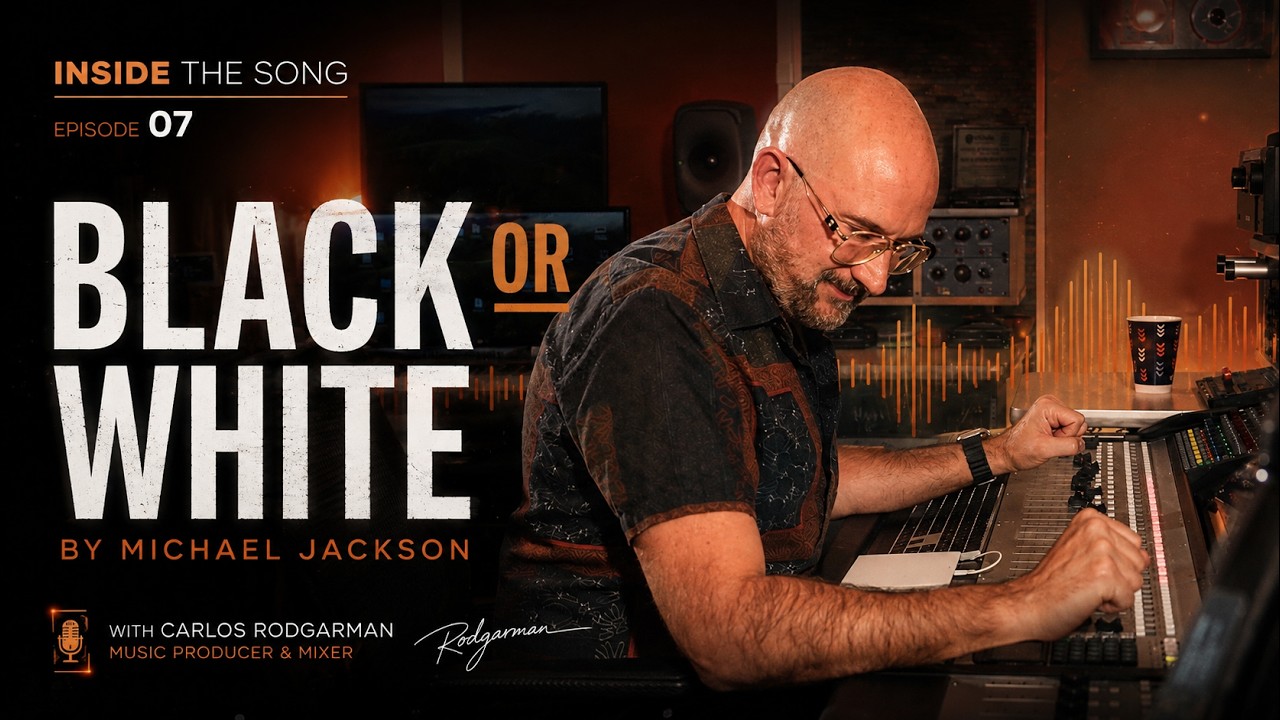
Inside the Song

Dentro de "Black or White": por qué suena tan poderosa

¿Quién no se acuerda de este riff?

"Black or White", el primer single de Dangerous, estuvo siete semanas en el número uno del Hot 100, y siempre ha sido una de mis canciones favoritas. Tuve el privilegio de mezclarla en Dolby Atmos con Humberto Gatica cuando reconstruimos el catálogo entero, las mismas sesiones de las que sale el análisis de Earth Song.

Este es un disco sobre la unidad: un solo groove constante, una sola idea constante, tirando de todos en la misma dirección. Y la producción lo dice aún más alto que la letra.

El vídeo que nos fundió en uno

Retrato de John Landis
John Landis, que dirigió el vídeo, como había dirigido Thriller. Foto: Pietro Luca Cassarino, CC BY-SA 4.0.

Todavía me acuerdo del vídeo. Fue una de las primeras veces que vimos el morphing en nuestras pantallas: una cara fundiéndose en la siguiente, sin corte. La tecnología había explotado unos meses antes en Terminator 2, y ese mismo año Michael la metió en un vídeo musical dirigido por John Landis, el mismo director con el que había hecho Thriller.

El mensaje no puede ser más simple: negro o blanco, basta ya de racismo, todos somos iguales. Y el vídeo enseña cómo un groove constante puede unificarnos a todos. Las caras van cambiando. El groove no.

Una intro que vive en dos habitaciones
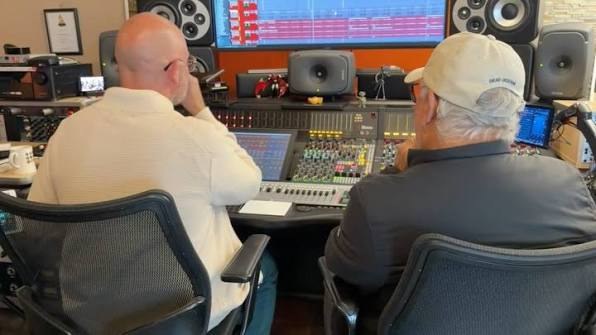
Carlos Rodgarman y Humberto Gatica en el estudio
Con Humberto Gatica, mezclando el catálogo de Michael Jackson en Dolby Atmos.

Esta intro fue divertidísima de hacer en Atmos. Acuérdate: el crío con el disco a todo volumen en su cuarto, y el padre llamando a la puerta.

En estéreo esa escena es un sketch. En Atmos es un plano de la casa. Pusimos al crío escuchando la música al fondo de la sala, y al padre llamando delante, «Papá, está muy alta, bájala», de forma que la discusión ocurre de verdad a través de la habitación, a tu alrededor.

Cada uno de esos canales es un objeto, que es como llama Atmos a un sonido que puedes colocar y mover por cualquier punto de la sala. La pista principal está en el centro, creando la unidad; el padre vive delante; el crío contesta desde atrás, «Papá, que esta es la mejor parte», y sabes exactamente dónde está plantado cada uno.

El riff es el espacio que lo rodea

Lo primero de lo que quiero hablar es, obviamente, el riff principal, y el secreto del riff principal es lo apretado que está. Es el espacio, en realidad: lo vacío, y lo poderoso, que es. Ese vacío es lo que le deja sitio al groove.

Y no está solo. Detrás lleva una capa de armónicos, muy grave, muy sutil, cantando una armonía baja debajo de la guitarra. Has oído este disco mil veces y seguramente nunca la has notado. Ponla en solo, y llevaba ahí desde siempre.

¿Te habías dado cuenta de que es un blues?

Para una canción que se llama «Black or White», ¿qué ciclo armónico hay más unificador y más universal que el blues?

Es un blues de doce compases en Mi, la tonalidad perfecta para las guitarras y para el riff. Voy a intentar tocarlo al piano, que obviamente no es lo que hace la guitarra, pero se entiende: cuando entra Michael, la estrofa recorre los doce compases exactamente como los escribió la tradición.

Dos pentagramas en Mi mayor: la tríada de tónica que pide la tonalidad y la tónica del blues, el mismo acorde con la séptima bemol añadida, Re natural 1 · lo que pide la tonalidad E 2 · la tónica del blues E 7 ♭7
La tríada de tónica de Mi mayor, y la tónica del blues sobre la que corre la canción: el mismo acorde con la séptima bemol, Re natural, encima.

Esa es la paradoja del blues en un solo acorde: en Mi mayor nadie ha pedido un Re natural, y el blues lo planta justo en la tónica. Esa séptima bemol es lo que hace que un riff de pop suene más viejo y más grande que el pop.

El groove está hecho de espacio

Ahora, cómo se monta el groove, pieza a pieza. Primero: ¿habías pillado alguna vez ese sonido tan característico, esa ranita en la caja?

Luego el bajo de sintetizador. Enorme cuando habla, y después se aparta. Deja muchísimo espacio. Esa es toda la filosofía de esta producción: todo golpea, y todo se quita de en medio.

Michael va muy seco, pegado a tu cara, y solo hay un tecladito colándose en el ciclo, y únicamente en el quinto grado. Cuenta los elementos: casi no hay. Por eso suena tan grande. Es la misma lección que el análisis de Don't Stop 'Til You Get Enough: el groove está hecho de lo que dejas fuera.

La guitarra acústica de la que nadie habla

En la segunda estrofa entra una guitarra acústica, y le da al disco muchísima más potencia. El riff ya está en marcha; esta se acopla encima. Apretada. Apretadísima.

Y ¿nos cansamos alguna vez de ver el groove de Michael? Su respiración, su todo. Cómo cabalga esta estructura es un instrumento en sí mismo.

Romper la estructura

La canción es una estructura constante que se repite, y esa es la gracia: un solo groove para todos. Entonces, ¿cómo la rompe? Con ese secuenciador loco, que en Atmos es divertidísimo, girando la sección alrededor de la sala. Y en el puente que da vueltas antes del rap, nos vamos al menor. Un cambio interesante: la primera vez que el disco sale de casa.

Después, el rap. Debajo hay una guitarra muy funky haciendo un riff muy funky, jugando con la sexta del acorde.

Un acorde de Mi mayor y el mismo acorde con la sexta añadida, Do sostenido, la nota con la que juega la guitarra funky del rap 1 · el acorde E 2 · con la sexta E 6 6
El acorde de Mi del riff, y el mismo acorde cuando la guitarra funky le añade la sexta, Do sostenido.

Y ¿podemos hablar de esa transición al rap? Toda la locura se recoge y hace el relevo, y el rap aterriza como un descanso para el oído: después de la densidad anterior, de repente hay guitarra, percusión y una voz. Escucha la guitarra ahí. Es funky de verdad.

Un final entre amigos

Después del rap volvemos a la estructura del blues. Vamos al cuarto grado, llega la vuelta del ciclo, y la canción se queda a vivir en la jam final.

Y entonces, un final muy interesante para su época: todo se retira y acaba casi acústico, como si fuerais todos amigos tocando juntos en una habitación, y simplemente se termina la canción.

Lo que hay que llevarse

Michael iba adelantado a su tiempo en muchísimas canciones, y mucho de lo que nos contaba, la humanidad lo sigue repitiendo. El mensaje de este disco no ha caducado.

La lección de producción tampoco: la potencia no es apilar, es espacio. Un riff que deja sitio, un bajo que habla y se aparta, y el ciclo armónico más universal que existe, escondido a plena vista debajo de uno de los discos de pop más grandes que se han hecho.

Tenemos que volver a escuchar. Y hacer ese cambio.

Transcripción completa (en inglés)
  1. 0:00 Hi, Carlos Rodgarman here. And I just want to ask you, who doesn't remember this?
  2. 0:09 Right, iconic. This is another legendary song that I got the privilege of mixing in Dolby Atmos with Humberto Gatica when we rebuilt all the catalog into Dolby Atmos.
  3. 0:20 This was the first single of the album Dangerous. It was 7 weeks number one in the US Hot 100.
  4. 0:26 And this has always been one of my favorite songs. I still remember the video.
  5. 0:31 Remember that video where it was one of the first times actually that we were seeing this morphing technology in video? I believe it started with the movie Terminator 2, if I'm correct. I don't know. You guys can tell me if I'm wrong on that.
  6. 0:45 But then Michael used it in this video and it just showed this whole message: black or white, enough with the racism, we're all the same.
  7. 0:52 And it actually shows through the video how just one consistent groove, one consistent thought can unify all of us.
  8. 0:59 First of all, it was so much fun to do in Atmos this intro. Remember the intro with the kid listening to the music?
  9. 1:11 So, in Atmos what we did is we're putting the kid listening to the music in the back, and then the dad is coming knocking: "Dad, it's too loud. Bring it down." So, dad is in the front.
  10. 1:22 So, there's this dialogue in Atmos.
  11. 1:29 You can see we have here this track, right, that is in the middle creating unity in the room.
  12. 1:37 This is in the front where the dad is going to be, and this one is in the back where the kid is listening to the music.
  13. 1:48 "Dad, this is the best part."
  14. 1:57 You can see how the panning, we're moving the object, which is what all these channels are called in Dolby Atmos.
  15. 2:04 The first thing that I want to talk about is obviously the main riff. The secret of this is how tight it is.
  16. 2:11 It's the space actually. It's how empty, powerful, and empty it is, so that creates space for the groove, right? Listen to the guitar riff.
  17. 2:25 Which has a layer actually of these harmonics behind. Very low, very subtle.
  18. 2:34 You see how it's doing that low harmony? I'll bring it up so you can hear it.
  19. 2:45 For Black or White, what harmonic cycle more unifying and universal than the blues. Did you realize it's a blues?
  20. 2:52 It's in E. Right? Because it's the perfect key for the guitars and for the riff, right?
  21. 2:59 So, the main riff is going to be something like — I mean, I'm going to try to do it on piano, which is not the same. Obviously, I can't do what the guitar does, but you'll get this.
  22. 3:15 So, the interesting thing when he comes in: it starts the blues progression, as we know, the 12-bar progression.
  23. 3:48 The next element is actually to show you how the groove is built.
  24. 3:58 Did you catch that signature sound, that little frog on the snare?
  25. 4:11 Then the synth bass, it's also so powerful when it speaks, but then it gives so much space.
  26. 4:24 So, it's all about the space. Listen to that in the context of the full riff of the full song.
  27. 4:43 And we have Michael very dry in your face. We just have that small keyboard that comes in on the cycle, in the blues cycle.
  28. 5:02 It comes on the five.
  29. 5:15 Now, for the second round, second verse, there's this acoustic guitar that comes in and it gives so much more power.
  30. 5:21 We already have the riff going, but listen to this one that comes in. Tight. Super tight.
  31. 5:31 So, listen to that when the second verse comes in.
  32. 5:45 Do we ever get tired of seeing Michael's groove? Just his breathing, his everything.
  33. 5:54 "But if you're thinking about my baby, it don't matter if you're black or white."
  34. 6:04 So, this is just a consistent structure that keeps repeating, right? Then, how does he break it?
  35. 6:11 Well, with this crazy sequencer that in Atmos is actually really fun.
  36. 6:25 For that crazy bridge that goes around before the rap, we're going to the minor. Which is an interesting change.
  37. 6:34 During the rap, there's a very funky guitar doing a very funky riff playing with the sixth of the chord.
  38. 6:53 Now, can we talk about that moment, that transition? Look what we're doing in Atmos. What a great transition into the rap.
  39. 7:06 "Protection for gangs, clubs, and nations, causing grief in human relations. It's a turf war on a global scale."
  40. 7:13 This gives us a nice ear break, right? From the craziness before we go into the next section. Listen to the guitar. It's so funky.
  41. 7:25 With the percussion, look at that.
  42. 7:38 In the context of the whole rap section.
  43. 7:48 And we're back to the blues structure. We go to the four.
  44. 8:01 So, now it's a turnaround and then we're going to stay on basically the jam out, right?
  45. 8:18 And then he has a very interesting ending for the time. Look at that. Just very acoustic, like you were all friends playing together, and we just end the song.
  46. 8:34 So many Michael songs where he was so ahead of his time, really. And a lot of the stuff that he was telling us, humanity still keeps repeating.
  47. 8:43 So, we need to listen again. Make that change.
  48. 8:48 Stay tuned for more song breakdowns and I'll keep reading as many comments as I can, and I'll try to do as many breakdowns as possible.
  49. 8:56 So, thanks for watching. Don't forget to like, share, and subscribe. See you soon.