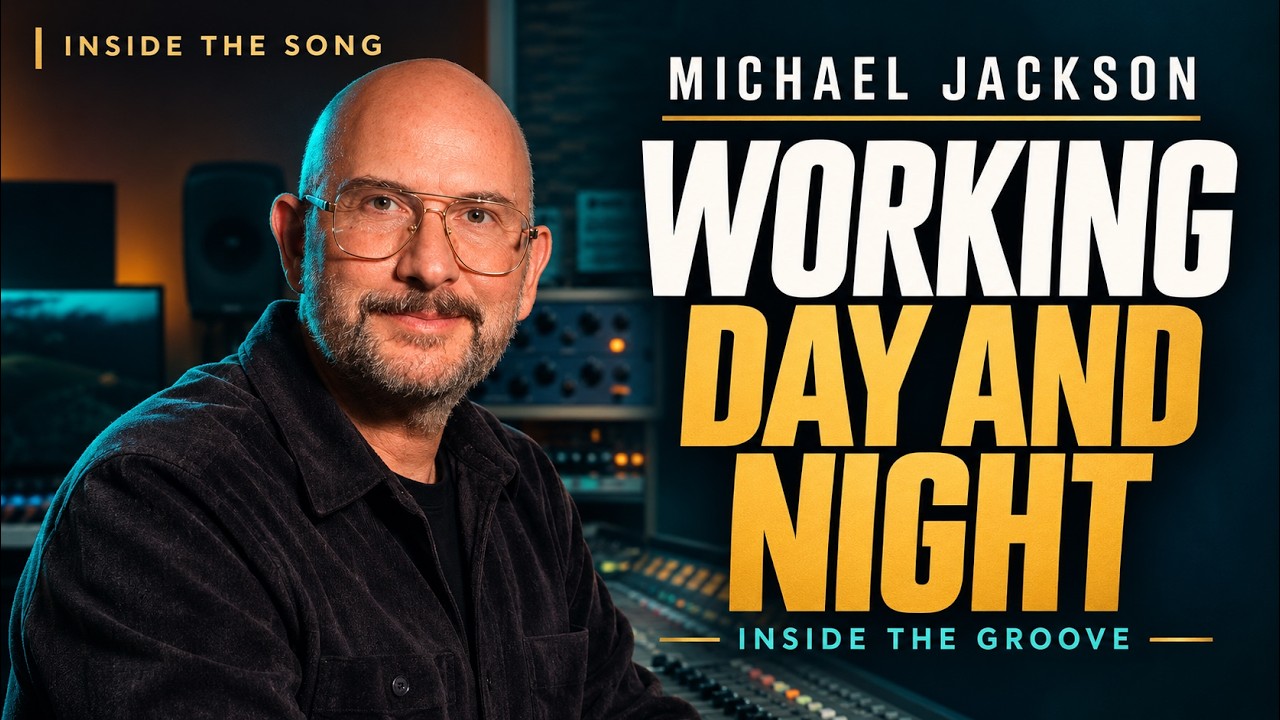
Inside the Song

Dentro de "Working Day and Night": cómo funciona el groove

Otra obra maestra de Off the Wall, y menudo jam.

Documentándome para este episodio descubrí que Off the Wall salió el 10 de agosto de 1979. Resulta que es el día de mi cumpleaños, así que ahora es todavía más mi disco favorito. "Working Day and Night" la escribió el propio Michael y la produjo Quincy Jones. Nunca salió como single: acabó en la cara B de "Rock with You", y es una de las canciones más rápidas que grabó.

Humberto Gatica y yo tuvimos el privilegio de remezclar todos estos discos en Dolby Atmos: Off the Wall, Bad, Dangerous, HIStory, hasta Invincible. Esta canción va de ritmo, la misma lección que el análisis de Don't Stop 'Til You Get Enough, del mismo disco. Te enseño cómo está construido el groove, pieza a pieza.

Un jam sobre el uno y el cuatro

La armonía es muy básica. Es un jam, un uno-cuatro, y solo hay un par de momentos en los que cambia para darle un giro. Todo lo demás es el groove y la repetición de las partes.

Dos pentagramas en Si menor: el acorde de Si menor, primer grado, y el de Mi menor, cuarto grado; el Si es la nota que comparten y no se mueve 1 · el uno B m 2 · el cuatro E m
Los dos acordes sobre los que gira el jam: Si menor, el uno, y Mi menor, el cuatro. Comparten el Si, así que el bucle nunca llega a salir de casa.

Dos acordes, Si menor y Mi menor, y la nota que comparten, el Si, no se mueve. Por eso puede seguir eternamente sin cansar: no hay destino, solo movimiento. Si quieres entender por qué tan poca armonía puede sostener tanto, esta canción es el ejemplo perfecto.

El piano aguanta ese uno-cuatro y un Rhodes lo dobla. Los dos están acreditados a Greg Phillinganes, al que también encontrarás en el análisis de Man in the Mirror.

Un tren que no para
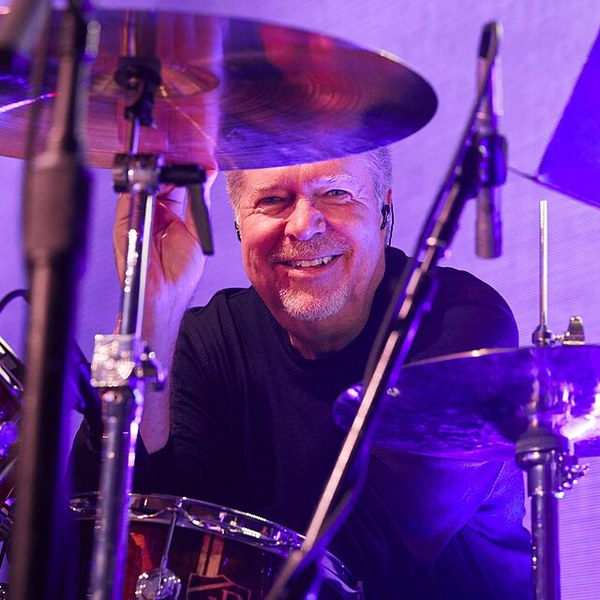
Retrato de JR Robinson a la batería
JR Robinson, el rey del groove, que también toca en I Can't Help It. Foto: Suzanne Teresa, CC BY-SA 4.0.

¿Cómo funcionan todos estos elementos juntos como un solo groove? Cada uno está colocado de forma brillante en su sitio, y todo consiste en encontrar el patrón que funciona. Esa repetición te mete en un trance, por decirlo así.

La batería apenas se mueve: algún detalle aquí y allá, y ya. Y encima de la caja está la palmada de Michael. Escúchala sola y verás cuánto aporta. Hasta se le oye el pie.

JR Robinson, el rey del groove. No hace ni un redoble en toda la canción. No hay platos en los tiempos fuertes, no hay toms. Es puro gusto constante, no sé decirlo de otra forma. Ve al final de la estrofa, a la entrada del estribillo, y fíjate en cómo la batería se queda exactamente donde estaba. Es un tren que no para, y eso es lo brillante de J.R. en todo este disco. Esa es la base.

Botellas, shaker y espacio
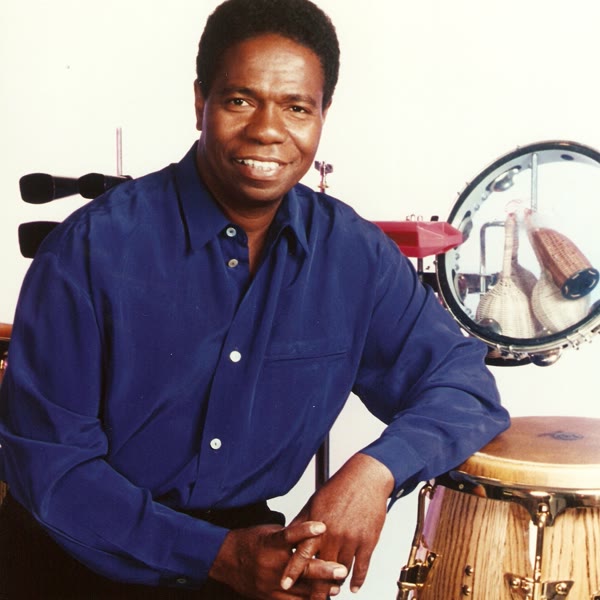
Retrato de Paulinho da Costa con sus instrumentos de percusión
Paulinho da Costa, acreditado a la percusión junto a J.R. y Michael. Foto: ALR, CC BY-SA 3.0.

¿Qué crea toda esa síncopa, todo ese movimiento? Un par de elementos. Uno son las famosísimas botellas, que trabajan junto a un shaker en el otro lado. La percusión del disco está acreditada a Paulinho da Costa, a J.R. y al propio Michael.

En Atmos tenemos, como siempre, la base en la pared frontal: la batería, con un poco del altavoz central para el bombo, la caja, algo de la voz y el bajo, según cuánto quieras traerlos. La percusión, como es la que crea toda esa síncopa, la abrimos un poco y la elevamos un poco. Eso crea un espacio muy bonito. ¿Por qué? Porque hay otro elemento del groove que vive a los lados, a la altura de los hombros: las guitarras. No exactamente en los hombros, un poco más abiertas.

Y hay otra guitarra que le contesta al groove principal, la que vas a reconocer. En Atmos también la pusimos en los hombros, para que las dos se hablen.

Michael es el groove
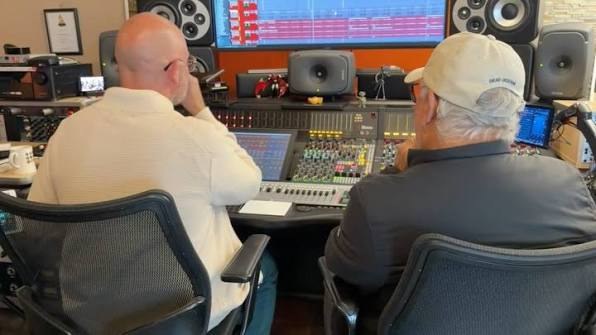
Carlos Rodgarman y Humberto Gatica en el estudio
Con Humberto Gatica, remezclando el catálogo de Michael Jackson en Dolby Atmos.

Sabemos que Michael mete todos estos ritmos con su respiración, los ruidos de su cuerpo, sus pisadas. Pero escucha la intro. Ya sabemos que empieza con las botellas y el shaker, pero en realidad todo se apoya en él: en una pista hace el groove entero con la voz, y luego se va a una segunda pista.

Todos sabemos esto de Michael, pero oírlo así es otra cosa. En el mundo Atmos, Humberto y yo dejamos siempre su voz principal en el centro cuando canta, y abrimos un poco los coros, para tener otra vez ese espacio.

Esto me encanta: hay un momento en el que empieza a cantar la parte de la guitarra justo cuando la guitarra tiene que entrar. La está llamando.

También hicimos algo divertido con los coros, el «uh» y el «ah»: se mueven a tu alrededor. En YouTube estás escuchando una reducción estéreo binaural de la mezcla en Atmos, así que lo que puede representar tiene un límite. Estoy empezando a codificar los próximos episodios en inmersivo, para que podáis apreciar un poco mejor el Atmos, según el equipo que tengáis.

Su voz en la estrofa va doblada, y no para. Luego llega el pre-estribillo, uno de esos momentos en los que cambia la armonía para romper. Fíjate en los coros ahí: hasta ahora no ha habido armonías vocales, y es justo ahí donde se abren a varias voces.

Los metales de Jerry Hey
Retrato de Jerry Hey
Jerry Hey, que arregló los metales, como en Don't Stop 'Til You Get Enough. Foto: Kamasami Kong, CC0.

Por supuesto, tenemos que hablar de los metales de Jerry Hey, tocados por los Seawind. Qué sección tan brillante, y con qué precisión la grabaron. Y qué bien les contesta Michael, y luego se va con ellos.

Después del segundo estribillo llega el puente, y ahí pasa algo bastante increíble. Está la sección de metales principal, la parte que vas a recordar, y me encanta oír el saxo barítono. Pero debajo hay una segunda capa. Humberto y yo la estábamos escuchando y le dije: «¿Esto está en la mezcla estéreo?». Está, si prestas mucha atención.

En Atmos todo se nota más porque los separamos: los metales principales van abiertos, y la segunda capa la cerramos un poco, para que haya una dinámica entre las dos. Escucha lo que hace la segunda. Qué precisión. ¿Qué desayunaban estos tíos?

Y Michael no se queda esperando a que pasen los metales para volver. Míralo. Luego llegan los golpes: el piano con los metales, y un plato que va con ellos. Esa guitarra, que tiene su propio doblaje, qué precisa. ¿Y has oído ese sintetizador? Otra cosa divertida que hicimos Humberto y yo: lo mandamos atrás.

El solo de timbales y el fundido

El grito de Michael, y luego la banda deja paso a los metales una vez más. ¿Y te acordabas de ese solo de timbales? Lo pusimos un poco atrás y un poco arriba, para que hable con el resto de la banda.

Luego el fundido final. Escucha a Michael ahí. Qué divertido. Y hay que reconocerle el mérito al piano.

Qué nos llevamos

Todo esto va de repetición. Cada parte es pegadiza a más no poder: cojas la que cojas, se te queda en la cabeza. Y todas trabajan juntas para convertirse en una sola cosa, una máquina que te hace seguir y seguir y seguir.

Vuelve a escucharla siguiendo cada vez un instrumento distinto: las botellas, la palmada, la guitarra que contesta, la segunda capa de metales. Cada vez vas a oír una canción distinta.

Transcripción completa (en inglés)
  1. 0:00 Hi, Carlos Rodgarman here, and welcome to another episode of Inside the Song. Another masterpiece, part of the Off the Wall album.
  2. 0:19 As you probably know by now, Humberto Gatica and myself have had the privilege of remixing in Dolby Atmos all these albums of Michael Jackson.
  3. 0:28 We've done Off the Wall, Bad, Dangerous, HIStory all the way to Invincible. Go check it out. You can stream this in any platform that supports immersive audio like Amazon, Tidal, Apple Music, etc.
  4. 0:42 But speaking about the album Off the Wall, this song what a jam. Doing a little research for this, I actually found out Off the Wall arrived August 10, 1979, which makes me so happy because that happens to be my birthday.
  5. 0:57 So now it's even more of my favorite album. This song is all about rhythm and as you guys already know, but let me just play you a little bit of the groove. Basically, it's This is a very basic It's like a jam.
  6. 1:08 It's like a one-four, right? And the And the harmony is very basic and there's only a couple of little moments where that changes to give it a little shift, but it's all about the groove and the repetition of the parts.
  7. 1:19 Let me play you this groove when it comes in here. Okay, let me actually mute Michael's vocal real quick so you can you can see all the groove.
  8. 1:48 Now, how does all these work together as one groove? There's so many elements and they're all brilliantly placed in the right spot. Let me show you the basis Again, this is all about finding that pattern that works and just that repetition puts you in this groovy trance, so to speak.
  9. 2:06 So, we have the It has some fills here and there, but basically that's it for the drums.
  10. 2:21 Look at this. We have also a Michael's clap that adds up to the snare sound.
  11. 2:40 Look at how much his clap is adding. Let me solo the clap. You can hear his foot. With the drums.
  12. 2:58 JR Robinson, the king of groove. He doesn't even do a fill in this whole thing. There's no crashes on the downbeats. There's no toms. It's just consistent yumminess.
  13. 3:09 I don't know how else to put it. You'll see what I mean.
  14. 3:20 Let's say that we go to the end of the verse into the chorus, which should be somewhere around You see how the drums stay?
  15. 3:40 It's just about this train that doesn't stop. That's what's brilliant about J.R. in this in this whole album. That's the foundation. What it's creating all this syncopation, all this movement, there's a couple elements.
  16. 3:52 One is the very famous bottles that we have. I'll play you the bottles That works together with a shaker on the other side.
  17. 4:19 Now, in Atmos we have as usual the foundation the drums. It's in the front wall. We have a little bit of the center speaker for kick snare, some of the vocal bass.
  18. 4:30 The main elements that depending on how much you want to bring them in. Now, this percussion because it's creating all this syncopation, we actually open it a little bit and then elevated it a little bit.
  19. 4:40 So, it creates this nice space. Why? Because there's another element that comes as a part of the groove that is going to be on shoulder sides, which is the guitars. I'll show you the guitars real quick.
  20. 4:52 Which is again another part that it's brilliant and it's just staying We can see the guitars.
  21. 5:05 We have them You see, they're not exactly at shoulder length, but a little bit open. Now, let me show you that together with the percussions that I just showed you.
  22. 5:17 Bottles, shaker. Now, let me show you that inside the track.
  23. 5:30 Let me mute the rest of the stuff for now. Right, with the track.
  24. 5:53 Now, there's another part of a guitar that actually answers to that main groove, which you'll recognize So, that was on this side a little bit as well.
  25. 6:05 In Atmos, we we placed it a little bit on shoulders, so together. Let me show you that in context.
  26. 6:32 So, now next we need to establish this is like I said, a one-four jam. So, the piano is holding it with this is together this piano. And we have a Rhodes doubling it.
  27. 7:03 In context. Now, we need to talk about Michael Uh we know that he's integrating all these rhythms with his breath, his noises in his body, his stepping, all that, but check out this intro.
  28. 7:22 Do you remember this intro? Listen to what's happening here.
  29. 7:40 We have on one side we have the right, we already know that we're starting with the bottles and the shaker. But, it's really all based on him.
  30. 7:50 Listen to this. So, we have on one side So, he's doing the whole groove by Uh but then he's going on a second track.
  31. 8:19 Look at what he's doing. We all know this about Michael, but hearing it like this.
  32. 8:42 So, let me play you both parts together. Now, again, uh Humberto and I, what we did is on and on the Atmos world, we keep his lead vocal always in the center when he's singing, but the backgrounds we open them a little bit, right?
  33. 8:53 So, that we have that again, that space. But let me play you this part. I mean, I love this.
  34. 9:13 There's a moment that he actually gives the He starts to sing the part for the guitar when he needs to come in. Listen. So, let me play you that within the track.
  35. 9:35 So, you see now when the guitar comes in how he's singing that See what I mean?
  36. 9:54 There's no crash in the Now, we did a little fun thing here with those backgrounds. We have this movement Ooh.
  37. 10:06 Ah. I know YouTube uh is usually you guys are listening in stereo and this is all stereo binaural reduction of the Atmos world.
  38. 10:16 So, there's so much that you can represent, but I'm actually starting to work on next episodes being encoded in the immersive so that from YouTube, you guys will be able to appreciate the Atmos a little bit better depending on your setup.
  39. 10:30 Now, let's listen to Michael's lead on that verse, which is doubled. You see what I mean?
  40. 10:43 He doesn't stop. Oh, I don't have to sing? So, this is basically the groove and the foundation of this whole track.
  41. 11:02 Look at when we go to the to the pre-chorus, the which is the only time that we're changing the harmony to break it up, right? Let me show you where that is. So, when that harmony change comes, look at the backgrounds how we're opening to harmonies cuz so far we've had no vocal harmonies.
  42. 11:38 Let me play that with his lead. With everything.
  43. 12:04 Obviously, we have to talk about Jerry Hey Look at this brilliant section. How tight they would record this. So,
  44. 12:34 How brilliant he answers and then goes with him with Michael. Listen. Brilliant.
  45. 12:52 We're back to the groove. The train keeps going. What happens after the second chorus? We go to the bridge. You'll remember this. So, there's something quite amazing here.
  46. 13:12 We have the main horn section, so to speak, which is the part that we'll remember. I love hearing the bari sax.
  47. 13:28 Uh but then underneath there's this. Which Humberto and I were listening and I was like, "Is this in the stereo mix?" It is in the stereo mix if you pay close attention.
  48. 13:38 In Atmos obviously uh everything is more apparent because we separate the horns and then the second layer that I'm about to show you, the horns are wide. Uh and then the second layer we close them a little bit so that there's this this dynamic between them.
  49. 13:52 But look at what the second is doing. So tight.
  50. 14:06 Listen to both of them What were these guys having for breakfast?
  51. 14:27 I don't know. So, let me show you all that now in context. Of course, Michael is not just like waiting for the horns to to pass and then come back.
  52. 14:51 Look at him. And then we have these beautiful hits.
  53. 15:09 So, the hits, as you can see, we have obviously the piano with the horns, which I'll play. But then we have this crash going with I'll show you.
  54. 15:26 Listen. You see? And then obviously that guitar part, can we talk about that?
  55. 15:39 Oh my god, listen to Which has this double.
  56. 16:00 So tight. Listen to both of them. In the context.
  57. 16:24 Did you hear that synth? Another fun thing Humberto and I did on this, we're actually throwing it to the back.
  58. 16:47 Again, look at Michael during this horn Again, this is all about the repetition, all the parts that are so so freaking hooky.
  59. 17:03 Every single part that you pick, it just stays in your brain. So, how all of them work together to become this one thing, this machine that just keeps you going and going and going.
  60. 17:24 I love that scream. There's that, and then there's this. Look at that, to give way to the horns one more time.
  61. 17:46 Did you remember that timbal solo? So, this one actually we placed it a little bit in the back and a little bit on top so that it's talking to the rest of the guys.
  62. 18:05 Listen in context again. And then we're fade out.
  63. 18:24 Listen to Michael on this fade out. So fun. So much fun.
  64. 18:49 Listen. Well, we got to give credit to the piano Stay tuned for more episodes inside the song.
  65. 19:17 I'm going to also be doing some other songs, not necessarily only Michael Jackson. Some of them that I've been a part of in some in some way or some songs that are just some of my favorites of all time and I want to dig in a little bit and see what we find.
  66. 19:30 So, like, share, and subscribe and stay tuned for the next episode. Thanks for