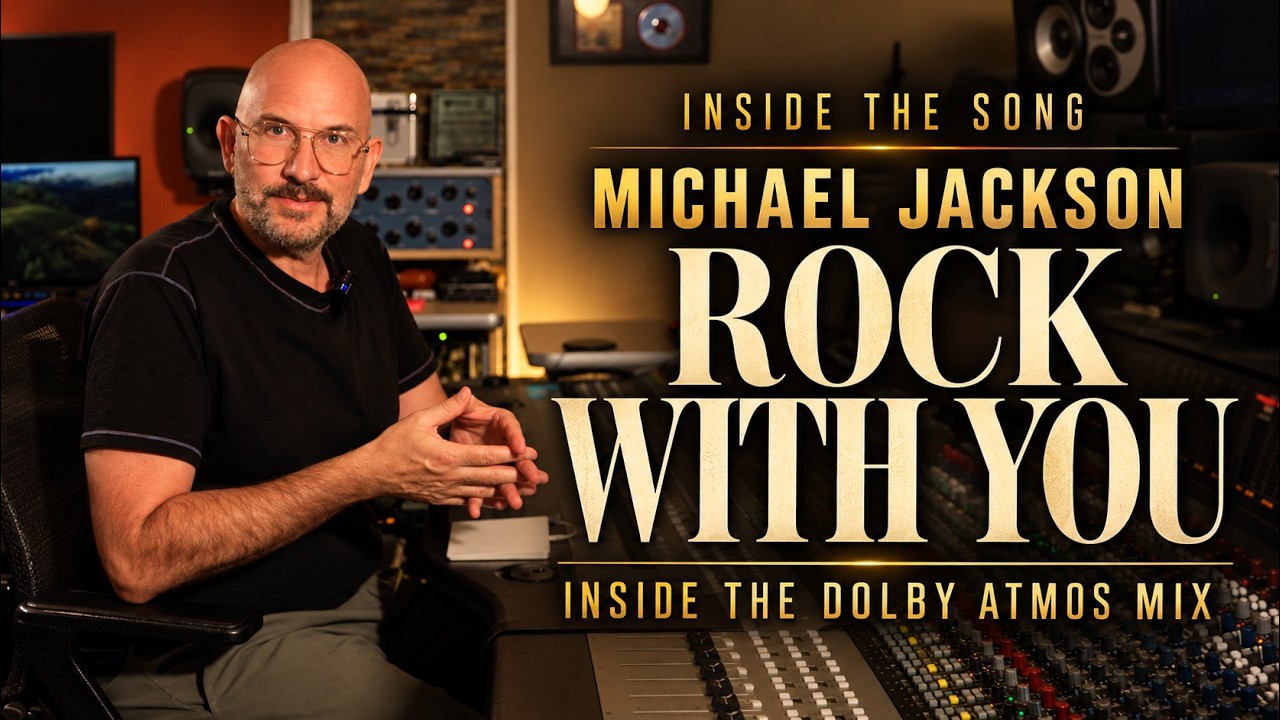
Inside the Song

Dentro de "Rock with You": cómo la llevamos a Dolby Atmos

Hay muy pocas canciones en la historia que no hace falta nombrar. Con un par de segundos de esa intro ya sabes cuál es.

"Rock with You", escrita por Rod Temperton y producida por Quincy Jones, fue el segundo single de Off the Wall y pasó cuatro semanas en el número uno del Hot 100 a principios de 1980. Junto a Humberto Gatica tuve la suerte de mezclarla en Dolby Atmos, dentro de todo el catálogo que rehicimos en inmersivo, las mismas sesiones de las que sale el análisis de I Can't Help It. El máster inmersivo es de Vlado Meller.

Es una grabación de 1979 que sigue sonando tan actual como el día que salió. En esta aprovechamos de verdad el espacio de Atmos para realzar la música, y quiero enseñarte cómo, elemento a elemento, desde la propia sesión.

La misma canción, traída a hoy
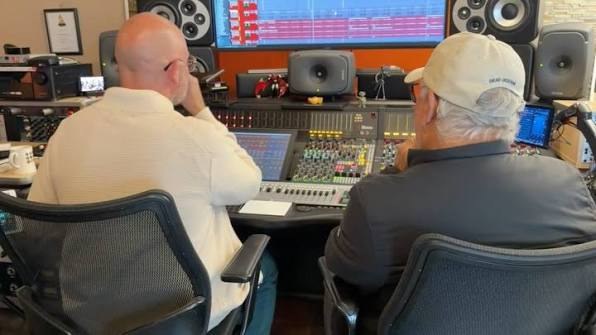
Carlos Rodgarman y Humberto Gatica en el estudio
Con Humberto Gatica, mezclando el catálogo de Michael Jackson en Dolby Atmos.

Todos llevamos años de recuerdos escuchando estas canciones. Así que lo primero que buscan estas mezclas es preservar ese recuerdo. Tiene que sentirse como la misma canción, y eso hay que respetarlo.

Al mismo tiempo, hay que traerla a hoy y aprovechar el espacio que tenemos en Atmos y que en estéreo no hay, porque entonces sencillamente no existía. Lo mismo pasa con los graves: en 1979 todo iba a vinilo, y un disco solo aguantaba cierta cantidad de graves y cierto volumen. Hoy ahí tenemos un pequeño lujo. El carácter se queda; lo que cambia es que Atmos nos deja abrir todo el esplendor de estos arreglos.

Y tiene que ser coherente. Mucha gente me dice que Atmos distrae, y es verdad cuando todo empieza a moverse por todas partes: arriba, detrás, delante. Siempre tiene que ir de la música. Una mezcla nunca debería sonar a demostración de la plataforma, ni de la tecnología.

Otros me dicen que el estéreo tiene una pegada que Atmos no tiene. Yo siempre respondo lo mismo: depende de lo que estés escuchando. Hay mezclas estupendas en estéreo y mezclas estupendas en Atmos, y también hay mezclas malas en estéreo. No se trata de lo que te permite el sistema, sino de lo que haces con él. Cómo usas esas posibilidades de más, para que apoyen la historia de la canción, es cuestión de gusto y de experiencia.

El groove empieza en el suelo
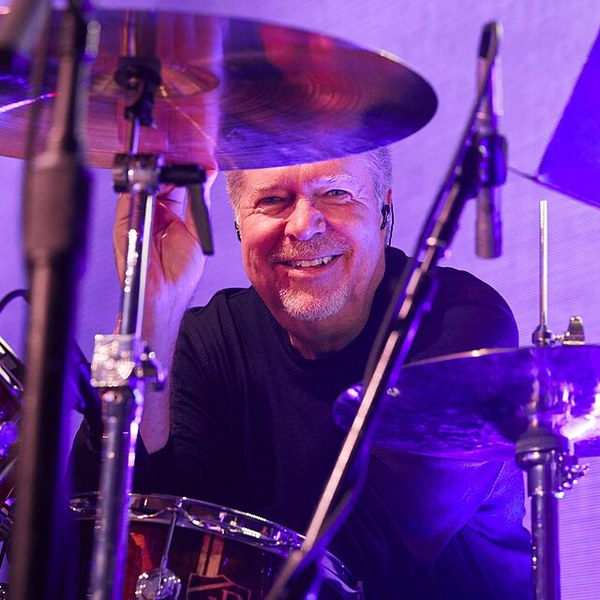
Retrato de JR Robinson a la batería
JR Robinson, a la batería aquí y en I Can't Help It. Foto: Suzanne Teresa, CC BY-SA 4.0.

Evidentemente hay que empezar por la batería. Ese sonido de batería es legendario, y es de JR Robinson. Escúchala sola un momento, deja entrar después la línea de bajo y oirás cómo arranca la canción.

Por encima, sosteniendo toda la intro, solo están las guitarras eléctricas, la otra pieza principal del groove, y el Rhodes apoyando la armonía. Tres cosas. No le hace falta más.

Aquí Atmos ya está trabajando. Las guitarras son un objeto, un sonido que puedo colocar en cualquier punto de la sala, en el 67-68 de la sesión. No están delante: un poco detrás de ti y casi sin elevación, prácticamente en el suelo. El Rhodes, en el objeto 65, va algo más abierto, casi a la altura de los hombros. Así las guitarras quedan un poco hacia fuera, pero no demasiado, porque van con la batería, y el Rhodes es el que da la anchura a esa altura, con la armonía.

La línea solista, en el 37-38, va delante pero un poco elevada, justo por encima de las guitarras. Juntas, la melodía y las guitarras forman una sola figura.

No le tengo miedo al canal central

Después, como siempre, el centro de atención es Michael, como tiene que ser. Siempre está en medio, delante.

Y no le tengo miedo al canal central. A unos les gusta y a otros no. Al principio de Atmos, muchos sellos y muchos productores pedían no poner al artista en el canal central, porque ahí la voz queda aislada y se la podían robar. Hoy, con la IA, cualquiera puede robar cualquier cosa igualmente.

Así que lo uso. No como foco principal de la voz, sino porque suena distinto del centro fantasma al que estamos acostumbrados en estéreo. Michael vive en el centro estéreo, y luego le meto tanto o tan poco canal central como pida la canción.

Tres reverbs, una sala
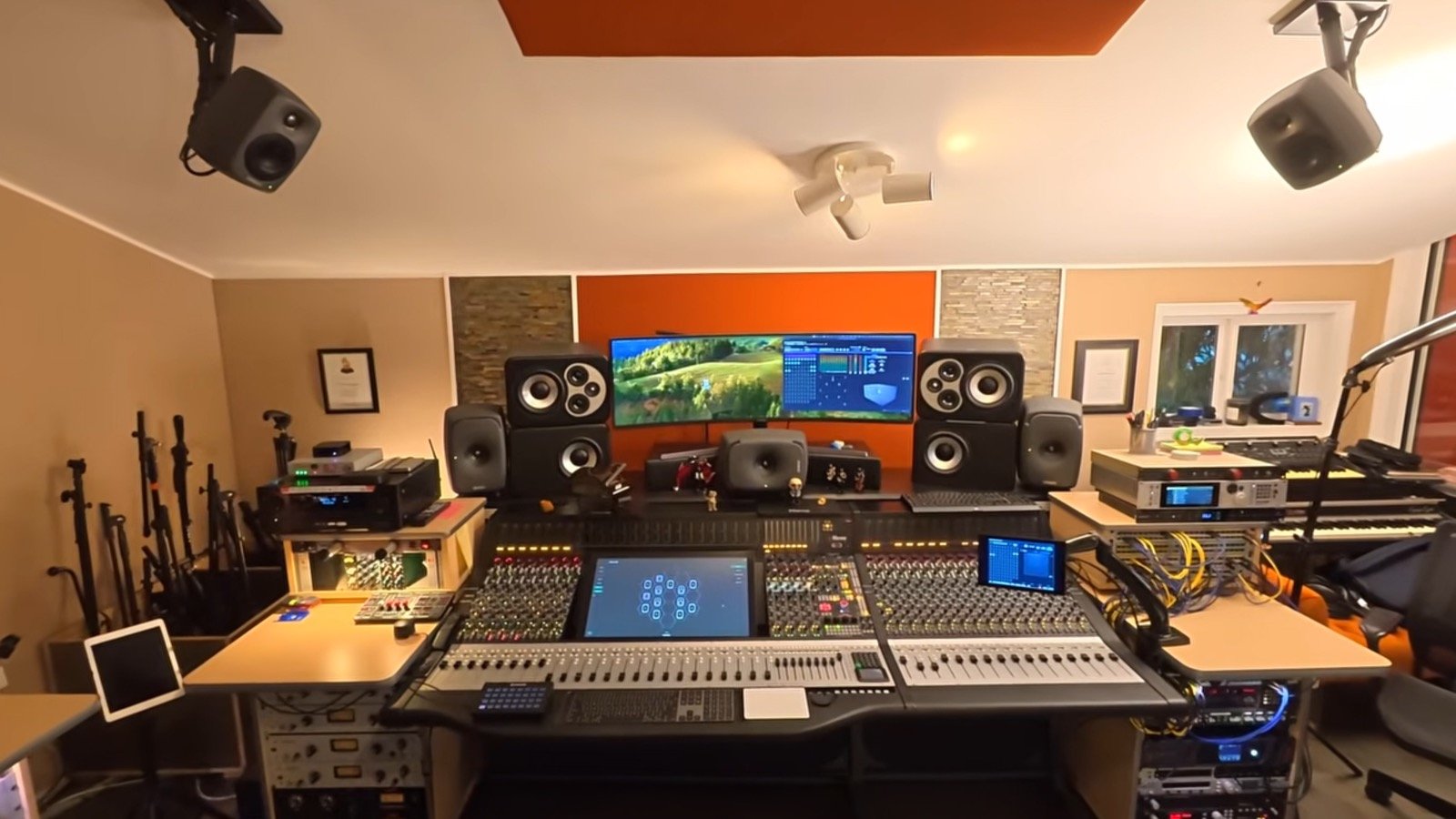
El control de RG Studio, con los altavoces de altura montados en el techo
La sala de RG Studio. Con altavoces alrededor y en el techo, la reverb se oye viajar de la pared de delante hasta el fondo.

Con las reverbs siempre intentamos recrear el ambiente del original, pero esto es otro medio. Para casi todas las reverbs de Michael he usado la Eventide H9000, y aquí monté tres instancias de tres reverbs: una corta, directamente en la pared de delante; otra algo más larga, en mitad de la sala; y la más larga, con un poco más de predelay, al fondo. Escúchalas de una en una.

Con auriculares, que es como la va a oír casi todo el mundo, te llega la emulación binaural, en Tidal o en el Audio espacial de Apple, y hace lo que hace; con cada actualización mejora un poco. Pero en una sala con altavoces, o con una de esas barras de sonido que proyectan contra las paredes y el techo para imitar los altavoces laterales y traseros, oirás cómo esa reverb pasa de corta delante a larga detrás. Oyes a Michael aquí y luego su estela viajando por la sala, hasta el fondo. Queda precioso.

Cuerdas, coros y metales

Entonces llega la magia: las cuerdas y sus coros. Las cuerdas, con arreglo de Ben Wright, están en el objeto 97-98, algo abiertas pero no demasiado, porque tienen que trabajar junto a los coros. Y los coros llevan una reverb parecida, la que viaja hacia el fondo.

El otro elemento que entra justo ahí son los metales, con arreglo de Jerry Hey, la misma mano que escribió los de Don't Stop 'Til You Get Enough. Están en el 69-70, a los lados. Así las cuerdas, los metales y las voces tienen cada uno su sitio, y ninguno tapa a los otros.

Las palmas de Michael

Algo en lo que merece la pena fijarse en el estribillo: es la primera vez que suenan las palmas de Michael. Escucha al rey del groove trabajando. En el preestribillo llegan esas semicorcheas preciosas en el charles, y luego las palmas caen en el estribillo, con la caja.

Es increíble lo bien que groovea con la caja tocada casi en el centro del parche, sin ningún golpe de más. Simplemente está ahí, en su sitio, grooveando. Es de lo que más me gusta de esta canción: suena muy íntima y aun así no deja de groovear. No es una balada, pero tampoco un tema rápido. Está en medio, y funciona.

La segunda estrofa

En la segunda estrofa, fíjate en el arreglo de cuerdas debajo de Michael. Abre su voz con su efecto junto a las cuerdas y verás lo bonito que se mueven juntas. Después se suman los metales y, para mis amigos bajistas, el bajo con la guitarra.

Y escucha cómo canta Michael. Cuánta energía, cuánto groove en sus respiraciones. Todos le conocemos por eso, pero sigue siendo asombroso ver cómo hace fluir el tema. Y sus armonías: brillantes, como siempre.

Por qué mi sesión está llena de cortes
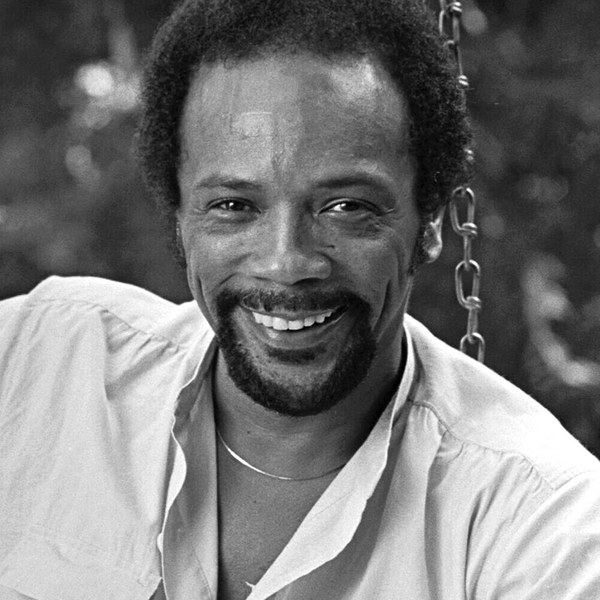
Retrato de Quincy Jones
Quincy Jones en 1980, el año siguiente a Off the Wall. Foto: Los Angeles Times, CC BY 4.0.

Si trabajas en esto y miras mi sesión de Pro Tools, te preguntarás por qué hay tantas ediciones en las regiones. Lo he contado en un par de entrevistas, pero merece la pena contarlo otra vez.

Este era un disco de músicos en directo, y todo era analógico. El audio digital no existía en 1979 como existe hoy. Se grabó en cinta, con Bruce Swedien a los mandos, se mezcló en cinta y se masterizó en cinta. Aunque las máquinas estén sincronizadas, en cada paso hay pequeñas fluctuaciones: en la grabación, en los overdubs, en la mezcla y en el máster.

Cuando intenté cuadrar nuestra mezcla nueva de Atmos con el estéreo original, no coincidía. Iba a otra velocidad y estaba en otra afinación: había subido. Se lo pregunté a Humberto y me dijo: «Seguramente, en el máster, Quincy o Michael aceleraron un poco la cinta para que sonara más emocionante». Ese pequeño acelerón subió un pelín la afinación, y el tempo con ella.

Así que tuve que dar con un porcentaje de aceleración, ahora en digital, para que cuadrara con el original y siguiera afinado. Funcionaba en un tramo y luego empezaba a desviarse, así que tocaba cortar, ajustar un poco más o un poco menos, y volver a cortar en la sección siguiente. Sección a sección, todo el disco. Solo eso fue muchísimo trabajo, pero había que hacerlo: la canción tiene que salir como la hemos oído siempre, a la misma velocidad y en la misma afinación. Eso son todos esos cortes. Lo cuento con más detalle en la guía de los discos de Michael Jackson en Dolby Atmos.

El puente y ese solo de sintetizador

Entramos en el puente. Qué arreglo, Jerry Hey. Abre el Rhodes para tener el contexto armónico, y el bajo, porque ahí hace unos movimientos muy funkys.

Y luego el solo de sintetizador. Memorable a más no poder: el sonido, la interpretación, la melodía. Después, las cuerdas nos llevan a la modulación.

Rodeado, y aun así íntimo

Luego llega el momento de Michael, y esta es una de las cosas bonitas que nos da Atmos, gracias al espacio. Hay muchísima música sonando. Michael está en el centro, saliendo un poco por el canal central; a su alrededor, los teclados y las reverbs; arriba, en la altura, un poco de las cuerdas y un poco de los efectos de teclado. Está rodeado. Eso deja sitio para sacar un poco los coros, y ahora hay un diálogo entre ellos y él.

Esa es la clave: hacer una canción inmersiva no significa que las cosas tengan que volar de izquierda a derecha. Pueden estar quietas y seguir sonando inmersivas. Y lo inmersivo no tiene por qué perder la pegada, ni la intimidad, como en esta canción.

Cuéntame cómo la escuchas

Qué disco tan glorioso es Off the Wall. Fue la primera colaboración entre Michael y Quincy Jones, el comienzo de su etapa adulta, y tengo mucha curiosidad por saber qué te parece en Dolby Atmos. También hicimos los demás discos: están todos en el proyecto Michael Jackson en Dolby Atmos.

Cuéntame dos cosas. Primero, cómo la escuchas: ¿auriculares, coche, tele, barra de sonido? ¿Qué equipo tienes? Y segundo, qué te gusta de Atmos. Mucha gente me dice que está descubriendo elementos musicales que nunca había notado en los originales. Siempre estuvieron ahí; no podemos añadir ni quitar nada. Pero con el espacio los oyes de otra manera, y entiendes un poco mejor esos arreglos tan bonitos.

Transcripción completa (en inglés)
  1. 0:00 Very few songs in history don't need to be named. We just need to listen to the first couple of seconds.
  2. 0:07 Hi, I'm Carlos Rodgarman, and I'm here to talk about Rock with You, another jewel on the Off the Wall album that, together with Humberto Gatica, we got to mix in Dolby Atmos as part of the whole catalog remixing that we did in Dolby Atmos.
  3. 0:23 This was mastered in immersive by Vlado Meller and Ander Rivas, and it's just another example of how brilliant this whole Off the Wall album is.
  4. 0:33 It's a recording from 1979 that still sounds as current today as it did when it came out.
  5. 0:39 This is another legendary song in which we actually took the space of Dolby Atmos to enhance the music.
  6. 0:45 We all have memories, for so many years, of listening to all these songs. So the purpose of these Dolby Atmos mixes is to preserve the memory that we have. It needs to feel like the same song. We need to respect that.
  7. 0:57 But at the same time, we need to bring it to today and take advantage of the space that we have in Atmos that we don't have in stereo. It didn't exist back then, right?
  8. 1:05 Same thing with the low end. There were limitations at the time, because this was all going to vinyl. There was only so much low end on vinyl, certain loudness, certain considerations to keep in mind. It's different today. So today we have a bit of a luxury of different things.
  9. 1:24 We need to respect the same character of the song. But Dolby Atmos allows us now to open up all the glory of these incredible arrangements that I'm going to show you.
  10. 1:31 It needs to feel coherent, because sometimes a lot of people tell me, well, you know, Dolby Atmos is just kind of distracting, when people start to do so many movements everywhere, top, back, front, and it gets distracting.
  11. 1:46 It needs to be always about the music. It should never feel like a demo of the platform, never a demo of the technology.
  12. 1:52 Some people tell me the same thing: stereo has a punch that Dolby Atmos doesn't have. I'm always saying, well, it depends on what you're listening to. In stereo it's no different than in immersive: what mixes are you listening to?
  13. 2:08 Because there are great mixes in stereo, great mixes in Atmos, and there are bad mixes in stereo too. So it's not so much what the system allows you to do, it's what you do with it. And that doesn't differ from stereo to immersive.
  14. 2:23 Now we have more possibilities in immersive, and how you use them creatively or musically, so that it feels coherent and supports the story of the song, that is a matter of taste and a matter of experience.
  15. 2:35 Obviously we need to start with the drums. That drum feel is legendary. Let me just solo the drums real quick.
  16. 2:57 Let me open it with the bassline, so you see how it starts.
  17. 3:17 Besides that, to support this whole intro, we just have the electric guitars, the other main part of the groove, together with the Rhodes supporting the harmony.
  18. 3:46 One interesting thing that we're starting to do already is the guitars, right? I have them here as an object, which I'm panning. We can see it here, 67-68.
  19. 4:01 So we have them not in the front, a little bit behind, and almost nothing elevated. They're pretty much on the ground, right?
  20. 4:12 But the Rhodes is a little bit wider. It's on object 65, which is this. As you can see, it's a little bit wider, so it's almost at shoulder level.
  21. 4:26 So this way we're keeping the guitars a little bit out, not too much, because they're together with the drums. They should feel together with the drums. The Rhodes is what gives us the width at this level, with the harmony. Let me play everything again.
  22. 5:02 Did you catch that?
  23. 5:12 Then of course we have the solo line, on 37-38. This object, 37-38, is pretty much in the front, but we have it a little bit elevated, so that it sits a little bit on top of the guitars, which were also out a little bit. So together, the lead with the guitars would be these two.
  24. 5:55 Then obviously, as always, the center of attention is Michael, as it should be. So we always have Michael in the middle, in the front.
  25. 6:05 But I'm actually not afraid of the center channel. Not afraid. Some people like it, some people don't.
  26. 6:13 In the beginning of Atmos, a lot of labels, a lot of producers were requesting not to put the artist in the center channel, because then it's isolated and people could steal it. These days, with AI, anybody can steal anything anyway.
  27. 6:28 So I'm using the center channel, not as the main focus of the vocal, but because it does have a different sound, right? The center channel is different from the phantom center that we're used to in stereo.
  28. 6:41 So we keep him in the stereo center, but then we bring in as much or as little as we need for the song on the center channel.
  29. 7:04 For the Atmos versions of these reverbs, we always try to recreate the same vibe of the original, right? But obviously this is different. In this case, I've been using the Eventide H9000 for most of Michael's reverbs.
  30. 7:22 What I created here was three instances of three reverbs. We have one that is straight up on the front wall, a second one that is a little bit longer, in the middle of the room, so to speak, and a longer one with a little more pre-delay in the back.
  31. 7:38 So you can hear: this is the first one, on the front wall.
  32. 7:50 You have the second one, in the middle of the room.
  33. 8:04 And then you have the back one.
  34. 8:27 What this does when you're listening on headphones, and most of you are going to be listening on headphones, on the binaural emulation that you get, whether it's on Tidal or on Spatial Audio on Apple, it does what it does. Every time it gets updated, it gets a little bit better.
  35. 8:44 But when you listen in a room with speakers, or on a soundbar, and today we have a bunch of soundbars that do different projections to the walls and ceilings to emulate back speakers, side speakers, etc., you will hear how this reverb goes from shorter in the front to longer in the back.
  36. 9:01 So effectively, you're hearing Michael here, and then you're hearing this trail in the room that keeps traveling to the back. It's really neat. Can we play it? With everything.
  37. 9:25 So you can see in the track what that reverb is doing.
  38. 9:50 This whole verse is being supported by the Rhodes.
  39. 10:17 Now, this is where the magic comes in. We have the strings and his backgrounds coming in. Look at the strings.
  40. 10:30 The strings, we have them on object 97-98, which is right there. So you can see that they're a little bit wide. Not too much, not too far out, because they should be working together with the backgrounds. I'll show you.
  41. 10:52 The backgrounds are actually here. Background vocals, these guys here.
  42. 11:06 And same thing, we have a similar type of reverb on them that travels to the back. So, together with the strings.
  43. 11:28 The other element that comes in right there is the brass, right? Which is on object 69-70. I'll show you. These horns are actually on the sides, so that we have the strings, the horns, and the backgrounds.
  44. 12:04 Let's see how all those elements are working together in the mix.
  45. 12:37 It's worth mentioning here, on the chorus, it's the first time that we introduce Michael's clap. Listen to the king of groove. Yes, sir. Listen to his work here.
  46. 12:54 When we go into the pre-chorus, I'll include the hi-hat, those beautiful sixteenth notes on the hi-hat. This is where we introduce the clap on the chorus, on the snare.
  47. 13:34 It's actually amazing how groovy it feels. The snare is played pretty much in the middle of the drum, no extra impact, and it's just grooving. It's just sitting there.
  48. 13:44 That's one of the beautiful things that I love about this song: how it feels so intimate, but at the same time it's still grooving. It's not a normal ballad, or a normal uptempo either. It's somewhere in between, and it just works.
  49. 13:58 Let me play you the chorus again, so you can hear that groove on the drums with the claps.
  50. 14:20 Now, the second verse.
  51. 14:37 I know, my bass friends... But before we talk about that, I need to show you the strings. Look at this arrangement.
  52. 14:46 I'll open Michael with his effect, so you can see those beautiful strings together with him. Listen to this.
  53. 15:20 Let me include the brass in there, because it's an important element that gets added there.
  54. 15:42 So, again, with everything in there.
  55. 16:03 Okay. Let me do this for my bass players. With the guitar.
  56. 16:39 Now listen to Michael's delivery. So beautiful, as always. So much energy, so much groove that he puts in his breaths. We all know him for that, but it's pretty amazing to see how he makes the track flow.
  57. 17:22 Now, some of you who are in this world and understand what I'm showing here in Pro Tools are going to wonder why there are so many edits on the regions. Why is all this stuff here?
  58. 17:33 I've spoken about this in a couple of interviews, but in case you haven't heard it, it's actually pretty interesting. This was an album of live musicians, and everything was analog, right? Digital audio didn't exist in 1979 the way it exists today.
  59. 17:53 So basically, this was all recorded live to tape. It was mixed on tape and it was mastered on tape. So there are all those fluctuations, even though the machines are synced: little fluctuations during recording, during overdubs, during mixing, and then during mastering.
  60. 18:12 It got to the point that I was trying to match the stereo mix to what we were doing in the Dolby Atmos mix, the new one that we're creating. It needs to sync, it needs to match the original, obviously. And then I find that it's at a different speed. It's at a different pitch. It actually came up.
  61. 18:32 So I was talking to Humberto, and Humberto says, "Well, probably at the time, what they did in mastering is that either Quincy or Michael just sped up the tape, to make it more exciting."
  62. 18:44 So that little speed-up actually brought up the pitch a tiny bit, and also the speed. So the original recording that we have, once we mix it, doesn't match.
  63. 18:56 So I had to come up with a percentage of speed-up, digitally these days, so that it would match the original and be in tune. But that would work maybe for a segment, and then it would start to drift.
  64. 19:11 So I would have to cut there, stop there, do a little bit more or a little bit less, and cut again in the next section. Section by section, I had to do this through the whole album.
  65. 19:22 That alone was a lot of work, but it needs to be done, because it needs to come out how we've all heard it: at the same speed and the same pitch. It needs to match the original perfectly.
  66. 19:32 So that's the reason, in case you were wondering, that you see a lot of these edits. It's where I had to cut, speed up, move, etc.
  67. 19:42 Look at Michael's harmonies. Brilliant, as always.
  68. 20:08 We're going into the bridge.
  69. 20:19 What an arrangement, Jerry Hey. It's worth listening to that. I'll open the Rhodes for harmonic context, and the bass, because it's doing some really funky moves in there.
  70. 21:07 Incredibly memorable, this synth solo. The sound, the performance, the melody.
  71. 21:26 In context again.
  72. 21:40 To the modulation. The strings are going to take us there.
  73. 22:04 Then it's time for Michael to do his thing.
  74. 22:23 This is one of the beautiful things that we get in Atmos, because of that space. We have Michael, and there's so much music going on, right? Michael's in the center, a little bit coming out of the center channel.
  75. 22:35 We have all the keyboards, all the reverbs. We have, in the height, a little bit of the strings and a little bit of the keyboard effects, right? So he's surrounded.
  76. 22:43 So now the backgrounds, we're able to pull them out a little bit. Now there's this dialogue between the backgrounds and him, and it just works fantastically in Atmos.
  77. 22:55 So the key thing is that making a song immersive doesn't necessarily mean that things are going to be flying left and right. They could be static and it still feels immersive. And immersive doesn't have to lose the punch, or the intimacy, like in this case.
  78. 23:25 Glorious album, Off the Wall. If you get a chance to listen to it in Dolby Atmos, please let me know in the comments.
  79. 23:41 First of all, I'm curious about how you're listening. Are you listening on headphones? In a car, on a TV, a soundbar? What's your setup?
  80. 23:50 And number two, what are you liking about Dolby Atmos? The separation? A lot of people are starting to tell me that they're discovering so many musical elements they didn't realize were there in the originals.
  81. 24:01 Obviously, they are. We can't add or take away things that aren't there, right? But because of the space, now you hear things in a different way, and there's a different understanding of the gorgeous arrangements and so much musicality in these songs.
  82. 24:19 Especially this album, Off the Wall. What an album. So go check it out. I will leave the link here for the platforms that support Dolby Atmos.
  83. 24:28 We also did the other albums of Michael Jackson, but I'm very curious to hear what you think of Off the Wall in Dolby Atmos, since it was the start of Michael's adult era, right? This is the first Quincy Jones collaboration.
  84. 24:41 So I'm curious to see what you think. If you get to experience it in Atmos, please let me know. Thanks for watching. Don't forget to like and subscribe, and we'll see you in the next one.