
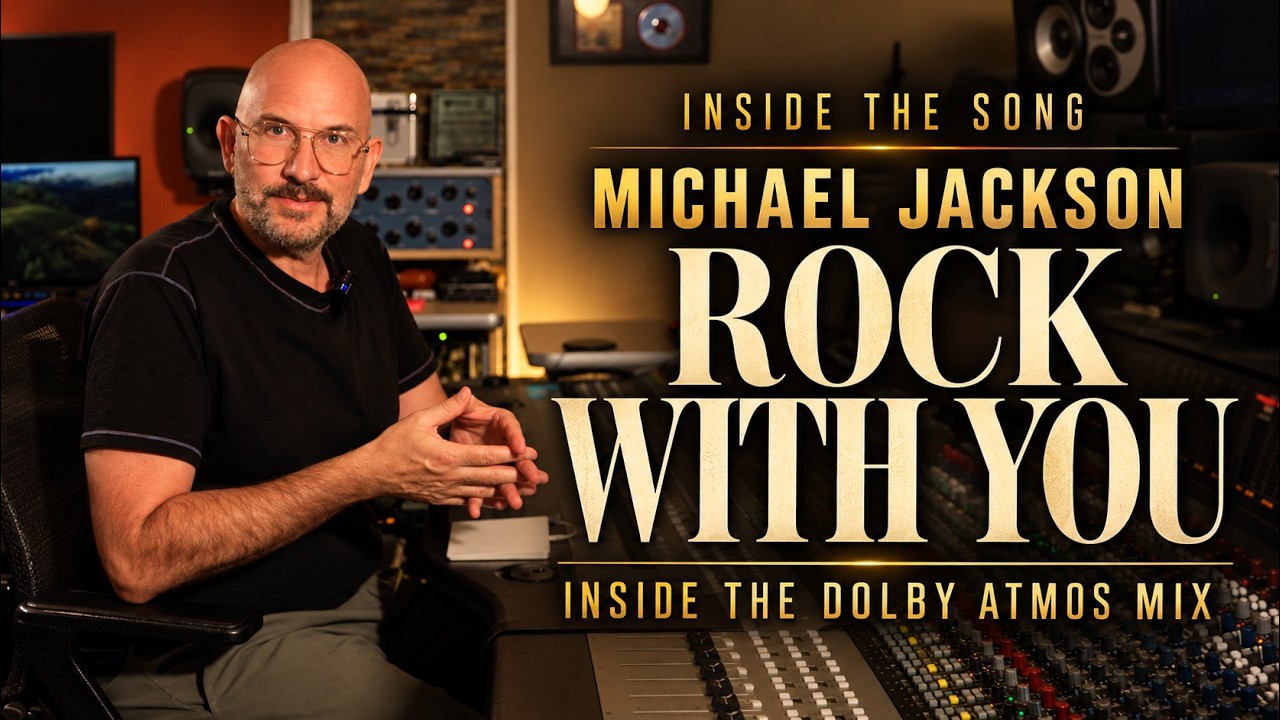
Very few songs in history don't need to be named. A couple of seconds of that intro and you already know.
"Rock with You", written by Rod Temperton and produced by Quincy Jones, was the second single from Off the Wall and spent four weeks at number one on the Hot 100 at the start of 1980. Together with Humberto Gatica I got to mix it in Dolby Atmos, as part of the whole catalog we rebuilt in immersive, the same sessions the I Can't Help It breakdown comes from. The immersive master is by Vlado Meller.
It's a recording from 1979 that still sounds as current today as the day it came out. On this one we really used the space of Atmos to enhance the music, and I want to show you how, element by element, straight from the session.
Same song, brought to today
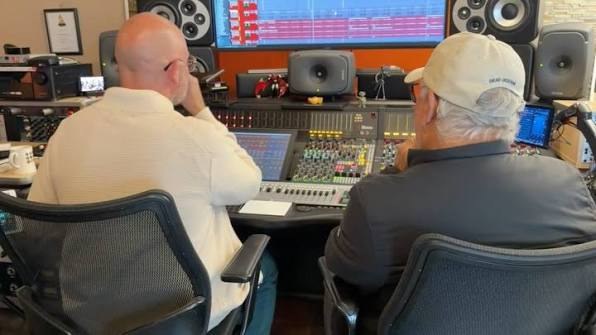
We all have years of memories listening to these songs. So the first purpose of these mixes is to preserve that memory. It needs to feel like the same song, and we need to respect that.
At the same time, we need to bring it to today, and use the space we have in Atmos that we don't have in stereo, because back then it simply didn't exist. Same thing with the low end: in 1979 everything was going to vinyl, and there was only so much low end and so much loudness a record could take. Today we have a bit of a luxury there. The character stays; what changes is that Atmos lets us open up all the glory of these arrangements.
And it has to feel coherent. A lot of people tell me Atmos is distracting, and it is, when everything starts moving everywhere: top, back, front. It always needs to be about the music. A mix should never sound like a demo of the platform, or of the technology.
Others tell me stereo has a punch that Atmos doesn't. My answer is always: it depends on what you're listening to. There are great mixes in stereo and great mixes in Atmos, and there are bad mixes in stereo too. It's not what the system allows you to do, it's what you do with it. How you use those extra possibilities, so they support the story of the song, is a matter of taste and a matter of experience.
The groove starts on the floor
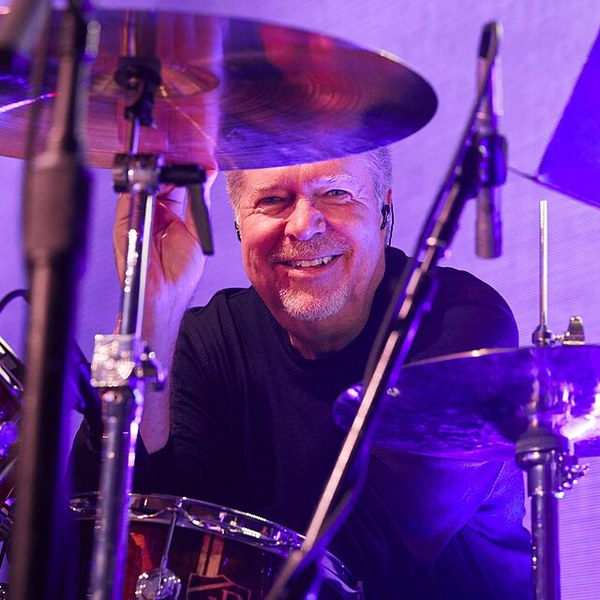
Obviously we need to start with the drums. That drum feel is legendary, and it's JR Robinson. Solo them for a second, then let the bassline in, and you hear how the song starts.
On top of that, carrying the whole intro, there are just the electric guitars, the other main part of the groove, and the Rhodes supporting the harmony. Three things. That's all the intro needs.
This is where Atmos is already working. The guitars are an object, a sound I can place anywhere in the room, on 67-68 in the session. They're not in the front: a little behind you, and almost not elevated at all, pretty much on the ground. The Rhodes, on object 65, is a bit wider, almost at shoulder level. So the guitars stay a little out, but not too much, because they belong with the drums, and the Rhodes is what gives the width, at that height, with the harmony.
The solo line, on 37-38, sits in the front but slightly elevated, just on top of the guitars. Together, the lead and the guitars make one shape.
I'm not afraid of the center channel
Then, as always, the center of attention is Michael, as it should be. He's always in the middle, in the front.
And I'm not afraid of the center channel. Some people like it, some don't. In the early days of Atmos, a lot of labels and producers asked not to put the artist in the center channel, because there the vocal is isolated and people could steal it. These days, with AI, anybody can steal anything anyway.
So I use it. Not as the main focus of the vocal, but because it has a different sound from the phantom center we're used to in stereo. Michael lives in the stereo center, and then I bring in as much or as little center channel as the song asks for.
Three reverbs, one room
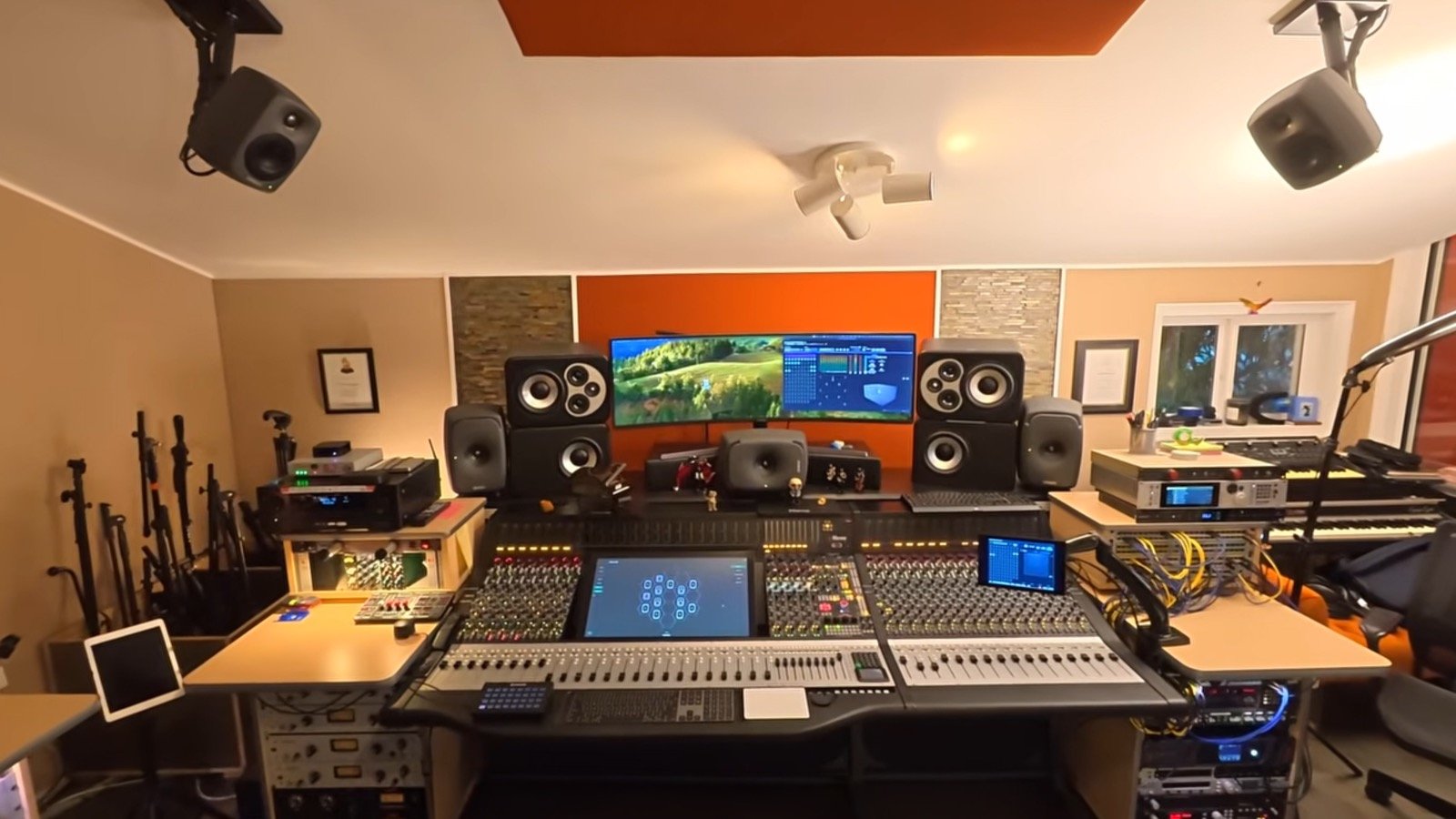
For the reverbs we always try to recreate the vibe of the original, but this is a different medium. For most of Michael's reverbs I've been using the Eventide H9000, and here I built three instances of three reverbs: a short one straight on the front wall, a slightly longer one in the middle of the room, and the longest one, with a little more pre-delay, in the back. Listen to them one at a time.
On headphones, which is how most of you will hear it, you get the binaural emulation, on Tidal or on Apple's Spatial Audio, and it does what it does; it gets a little better with every update. But in a room with speakers, or with one of the soundbars that project to the walls and the ceiling to emulate side and back speakers, you'll hear that reverb go from short in the front to long in the back. You hear Michael here, and then his trail traveling through the room, all the way to the back. It's really neat.
Strings, voices and brass
Then comes the magic: the strings and his background vocals. The strings, arranged by Ben Wright, are on object 97-98, a little wide but not too far out, because they have to work together with the backgrounds. And the backgrounds get a similar reverb, the one that travels to the back.
The other element that comes in right there is the brass, arranged by Jerry Hey, the same pen behind the horns of Don't Stop 'Til You Get Enough. It's on 69-70, and those horns are on the sides. So the strings, the horns and the voices each have their own place, and none of them covers the others.
Michael's clap
Something worth noticing on the chorus: it's the first time we hear Michael's clap. Listen to the king of groove at work. In the pre-chorus come those beautiful sixteenth notes on the hi-hat, and then the clap lands on the chorus, with the snare.
It's amazing how groovy it feels, with the snare played pretty much in the middle of the drum, no extra impact. It's just sitting there, grooving. That's one of the things I love about this song: it feels so intimate, and it's still grooving. It isn't a ballad, and it isn't an uptempo either. It's somewhere in between, and it just works.
The second verse
In the second verse, look at the string arrangement under Michael. Open his vocal with its effect next to the strings and you see how beautifully they move together. Then the brass gets added, and, for my bass friends, there's the bass with the guitar.
And listen to Michael's delivery. So much energy, so much groove in his breaths. We all know him for that, but it's still amazing to see how he makes the track flow. And his harmonies: brilliant, as always.
Why my session is full of cuts
If you work in this world and you look at my Pro Tools session, you'll wonder why there are so many edits on the regions. I've told this in a couple of interviews, but it's worth telling again.
This was an album of live musicians, and everything was analog. Digital audio didn't exist in 1979 the way it does today. It was recorded on tape by Bruce Swedien, mixed on tape and mastered on tape. Even with the machines synced, there are tiny fluctuations at every stage: recording, overdubs, mixing, mastering.
When I tried to line up our new Atmos mix with the original stereo, it didn't match. It was at a different speed and a different pitch: it had come up. I asked Humberto, and he said: "Probably, in mastering, either Quincy or Michael just sped up the tape, to make it more exciting." That little speed-up raised the pitch a tiny bit, and the tempo with it.
So I had to find a percentage of speed-up, digitally, to match the original and stay in tune. It would work for a segment and then start to drift, so I'd cut, adjust a little more or a little less, and cut again in the next section. Section by section, through the whole album. That alone was a lot of work, but it had to be done: the song has to come out the way we've all heard it, same speed, same pitch. That's what all those cuts are. I tell it in more detail in the guide to the Michael Jackson albums in Dolby Atmos.
The bridge and that synth solo
Into the bridge. What an arrangement, Jerry Hey. Open the Rhodes for the harmonic context, and the bass, because it's doing some really funky moves in there.
And then the synth solo. Incredibly memorable: the sound, the performance, the melody. After it, the strings take us to the modulation.
Surrounded, and still intimate
Then it's Michael's moment, and this is one of the beautiful things we get in Atmos, because of the space. There's so much music going on. Michael is in the center, coming out a little from the center channel; around him, the keyboards and the reverbs; up in the height, a little of the strings and a little of the keyboard effects. He's surrounded. That leaves room to pull the backgrounds out a bit, and now there's a dialogue between them and him.
That's the key thing: making a song immersive doesn't mean things have to fly left and right. They can be static and it still feels immersive. And immersive doesn't have to lose the punch, or the intimacy, like in this song.
Tell me how you listen
What a glorious album Off the Wall is. It was the first collaboration between Michael and Quincy Jones, the start of his adult era, and I'm really curious what you think of it in Dolby Atmos. We did the other albums too: they're all in the Michael Jackson in Dolby Atmos project.
Tell me two things. First, how you listen: headphones, car, TV, soundbar? What's your setup? And second, what you like about Atmos. A lot of people tell me they're discovering musical elements they never noticed in the originals. They were always there; we can't add or take away anything. But with the space, you hear them in a different way, and you understand those gorgeous arrangements a little better.