
Michael Jackson's Bad in Dolby Atmos: Inside the Mix
Bad (1987) is the album of the five I engineered in Dolby Atmos with Humberto Gatica where the past was sitting right next to me. Humberto was one of the recording engineers on the original sessions, so when we opened those multitracks, one of the people who had recorded them was in the room. People ask me whether Bad is really in Atmos, what changes compared with the stereo and how to listen to it. This is the story of the Bad mix, told from RG Studio, my room in Los Angeles.
Is Bad available in Dolby Atmos?
Yes. Bad is officially available in Dolby Atmos, in the new mix Humberto and I did for the Michael Jackson Estate and Sony Music / Epic Records, with immersive masters by Vlado Meller. It was one of the first three albums of the project to come out, together with Off the Wall and Dangerous, around the release of the biopic Michael in April 2026. HIStory and Invincible followed. The full list, including Thriller, which has its own Atmos mix by Serban Ghenea and John Hanes, is in my guide to Michael Jackson in Dolby Atmos.
The original record
Bad came out on August 31, 1987, produced by Quincy Jones and Michael. It was the third and last album they made together, after Off the Wall and Thriller, and it was the first album to put five singles at number one on the Billboard Hot 100: “I Just Can’t Stop Loving You”, “Bad”, “The Way You Make Me Feel”, “Man in the Mirror” and “Dirty Diana”.
The record went on the road with the Bad World Tour, with Greg Phillinganes as musical director. It was during that tour, in a hotel room in Vienna in 1988, that Michael wrote “Earth Song”, which did not come out until HIStory. I tell that story in Michael Jackson’s HIStory in Dolby Atmos.
An engineer from the original sessions
Michael Jackson is no longer with us, Quincy Jones is no longer with us, Bruce Swedien is no longer with us. Humberto is the last member of that team still here, and that is why this project could only be done the way we did it. When I said it at the sound:check Xpo masterclass in Mexico City, I put it like this: “There is one person who was part of that team and carries that essence, and that is Humberto Gatica.”
There were no Atmos stems waiting for us. In Sony’s archive there were the original multitrack tapes, so the work had two stages. First, Humberto rebuilt each song in stereo from the multitracks, so it sounded like the record everybody knows, and Sony approved that stereo. Then I took those stems into the immersive mix at RG Studio, through my Neve Genesys G3D console and a Genelec 7.1.4 system calibrated with GLM. That is the difference between a real Atmos mix and an automatic upmix, which I explain in can you convert a stereo song to Dolby Atmos?
Opening those sessions was something I will not forget. It literally gave me goosebumps: I would open a song and hear the vocals, the percussion, the instruments that Michael and Quincy had prepared, each one on its own.
“Man in the Mirror”: three voices, three places
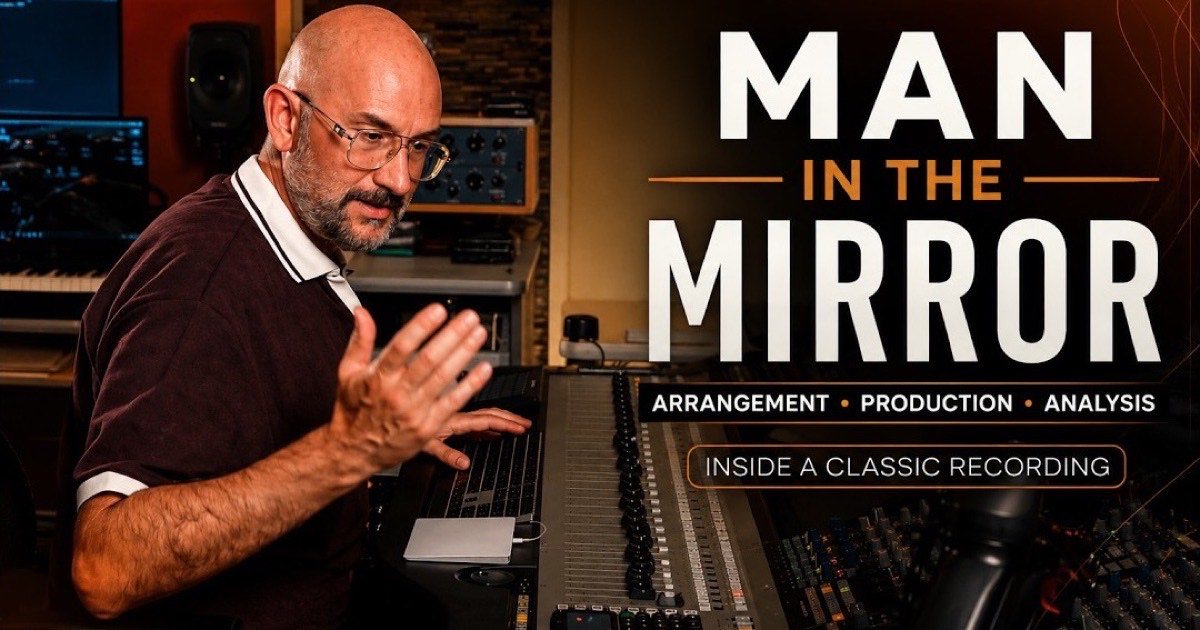
“Man in the Mirror” is the song on Bad that best shows what immersive audio is for, because the whole arrangement is about growing. It starts with a small bell figure and Michael, nothing else: no drums, no bass. Then an electric piano, then kick and snare, and only in the chorus does the bass come in, a synth bass rather than an electric one.
All through the first part Michael is very much in the center, center channel included. When the background vocals arrive, they first double him in unison and only then open into harmony, so they grow inside themselves the same way the song grows. That is when I open them outward: as the arrangement widens musically, the space widens with it. In Atmos you can finally do what the arrangement was describing all along.
In the last chorus everything stops, there is silence, and the gospel choir comes in. I placed the choir slightly behind you and slightly above, so it talks to the backgrounds instead of sitting on top of them. Michael in front, the backgrounds around him, the choir behind and above: three vocal layers in three distinct places, and the song still growing. Then the key change, straight up a half step into A flat. I go through the whole arrangement in Inside “Man in the Mirror”.
The piano that was always there
The thing I remember most from mixing Bad is a piano. Greg Phillinganes, the same musical director of the Bad World Tour, plays an acoustic piano part on “Man in the Mirror” with a deep gospel feel. It is on the original record, but in the stereo mix it lives underneath everything else. I had known that song for forty years and never really heard it.
Once you can separate the elements the way immersive lets you, the piano comes forward with real clarity. Listen to it once on its own, then inside the track, and you will not be able to un-hear it. For me that is the whole argument for doing this work: not spectacle, but recovering musical information that was on the tape the entire time.
What to listen for on Bad
The rule Humberto and I gave ourselves on the five albums was to respect the memory. Immersive is not permission to redecorate somebody else’s record, and these are not new versions of the songs: Michael stays at the center of the front image, and his voice rules over any spatial trick. On Bad, listen to the low end and to how the backing vocals open around you while Michael stays in front.
With the low end I am conservative: I first mix the song the way it already is, and then send an extra 20% to the LFE. I never rely on the sub to carry a mix. And instead of the usual 7.1.2 bed, I built the mixes as a bed of objects in 9.1.6, so they render natively on whatever plays them: AirPods, a soundbar, a 7.1.4 living room or a bigger room. On headphones, how close or far each element feels is set inside the mix with the Dolby Atmos binaural render mode. Making a song immersive does not mean things have to fly around the room. They can stay still and it still feels immersive, without losing the punch or the intimacy.
How to listen to Bad in Dolby Atmos
- Apple Music with Spatial Audio. Look for the Dolby Atmos badge on the album page: it tells you that you are hearing the Atmos version and not the stereo one. Other services that support Dolby Atmos, such as Amazon Music and Tidal, can carry the same mix.
- Headphones first. On an iPhone, go to Settings › Apps › Music › Dolby Atmos. With AirPods or Beats, “Automatic” is enough; with other headphones, choose “Always On”.
- Not on the phone speaker. It squeezes a lot of the work. If you only have the phone, use any headphones before the speaker.
- Offline. With “Download in Dolby Atmos” turned on in the Music settings, Apple Music subscribers can download the album in Atmos. It is not sold as a separate file, so “Bad Dolby Atmos download” files on other sites are not the official mix.
Frequently asked questions
Is Michael Jackson’s Bad available in Dolby Atmos?
Yes. Bad has an official Dolby Atmos mix by Humberto Gatica and Carlos Rodgarman, made at RG Studio in Los Angeles for the Michael Jackson Estate and Sony Music / Epic Records, with immersive masters by Vlado Meller. It is released for streaming.
Who mixed Bad in Dolby Atmos?
Humberto Gatica, one of the recording engineers on the original Bad sessions, rebuilt the stereo from the multitracks, and Carlos Rodgarman built the Atmos mix at RG Studio, on a Neve Genesys G3D console and a Genelec 7.1.4 system.
When did Bad come out in Dolby Atmos?
It was one of the first three albums of the project, together with Off the Wall and Dangerous, released around the premiere of the biopic Michael in April 2026. HIStory and Invincible followed.
Is “Man in the Mirror” in Dolby Atmos?
Yes. It is part of the Bad Dolby Atmos mix. Michael sits in the center, the background vocals open around him as the arrangement grows, and the gospel choir of the last chorus is placed slightly behind and above the listener.
Can I download Bad in Dolby Atmos?
Only inside the streaming service. Apple Music subscribers can download it for offline listening with “Download in Dolby Atmos” turned on. The Atmos version is not sold as a file, so downloads from other sites are not the official mix.
For the full story of the project, see the Michael Jackson in Dolby Atmos page, or read about the album that started it all in Michael Jackson’s Off the Wall in Dolby Atmos.