
Michael Jackson's Off the Wall in Dolby Atmos: Inside the Mix
Off the Wall (1979) is where the five Michael Jackson albums I engineered in Dolby Atmos with Humberto Gatica begin. It was the first collaboration between Michael and Quincy Jones, it was recorded entirely on analog tape, and it gave me the strangest technical problem of the whole project. People ask me whether it is really in Atmos, what changes compared with the stereo and how to listen to it. This is the story of the Off the Wall mix, told from RG Studio, my room in Los Angeles.
Is Off the Wall available in Dolby Atmos?
Yes. Off the Wall is officially available in Dolby Atmos, in the new mix Humberto and I did for the Michael Jackson Estate and Sony Music / Epic Records, with immersive masters by Vlado Meller. It was one of the first three albums of the project to come out, together with Bad and Dangerous, around the release of the biopic Michael in April 2026. HIStory and Invincible followed. The full list, including Thriller, which has its own Atmos mix by Serban Ghenea and John Hanes, is in my guide to Michael Jackson in Dolby Atmos.
The original record
Off the Wall came out on August 10, 1979, produced by Quincy Jones and Michael. At that point Quincy was known above all as a jazz arranger, and many people thought it was a strange pairing. What came out of it was the start of Michael’s adult era: “Don’t Stop ’Til You Get Enough” won him his first Grammy as a solo artist, and “Rock with You”, written by Rod Temperton, spent four weeks at number one on the Hot 100 at the start of 1980.
It is an album of live musicians: JR Robinson on drums, Greg Phillinganes on keys, Paulinho da Costa on percussion, Jerry Hey’s horns. Bruce Swedien recorded it on tape, and it was mixed on tape and mastered on tape. Digital audio did not exist in 1979 the way it does today, and that detail decided a big part of my work.
Starting from the tapes
There were no Atmos stems waiting for us. In Sony’s archive there were the original multitrack tapes, so the work had two stages. First, Humberto rebuilt each song in stereo from the multitracks, so it sounded like the record everybody knows, and Sony approved that stereo. Then I took those stems into the immersive mix at RG Studio, through my Neve Genesys G3D console and a Genelec 7.1.4 system calibrated with GLM. That is the difference between a real Atmos mix and an automatic upmix, which I explain in can you convert a stereo song to Dolby Atmos?
The record was faster than the tapes
When I lined up the new Atmos mix against the original stereo master, they did not match. The released record was at a different speed and a slightly higher pitch. Humberto’s explanation: probably, in mastering, Quincy or Michael decided to speed up the tape to make it more exciting, something many people did in the seventies. On tape, speed and pitch move together, so the song we have all heard for more than forty years is a little faster and a little higher than what is on the multitracks.
So I had to calculate how much it had been sped up and match it digitally. Because everything was analog, with tiny fluctuations at every stage (recording, overdubs, mixing, mastering), one percentage would work for a segment and then start to drift. I would cut, adjust a little more or a little less, and cut again in the next section. Section by section, through the whole album. If you ever see my Pro Tools session for Off the Wall, that is why it is full of edits: the songs have to come out at the same speed and in the same tuning as the record everybody knows. It is almost forensic work, and it is not in any Atmos manual, but it decides whether you recognize the song from the first bar.
Room for the groove
The rule Humberto and I gave ourselves was to respect the memory. On Off the Wall that meant keeping the original left-right decisions: wherever an element sat in the stereo, that is where it belongs. Immersive is not permission to redecorate somebody else’s record. What changes is separation. The rhythm section and the bass stay anchored on the front wall, the percussion lifts a little, and the parts that answer each other open out to the sides so you can finally hear them talking.
That matters on this album more than on any other, because the groove is split between players. In “Don’t Stop ’Til You Get Enough” nobody plays the whole groove: the drums hold one piece, the bass another, the percussion a third, and the clavinet plays counterpoint against the guitar. There is also a little figure in the handclaps with the backing vocals that I take to the back and bring forward again. I had never noticed it in forty years. In Atmos you can point the ear at something just by changing its position, without touching a fader. The whole song is broken down in Inside “Don’t Stop ’Til You Get Enough”.
In “Working Day and Night” the bottles and the shaker, which create all the syncopation, are opened and slightly elevated, and the guitars sit on the sides, a little outside the shoulders. Under Jerry Hey’s main horn section in the bridge there is a second layer that is on the stereo record if you listen closely; in Atmos the main horns are wide and the second layer is a little narrower, so you hear the two talking. More in Inside “Working Day and Night”.
“Rock with You” and “I Can’t Help It”
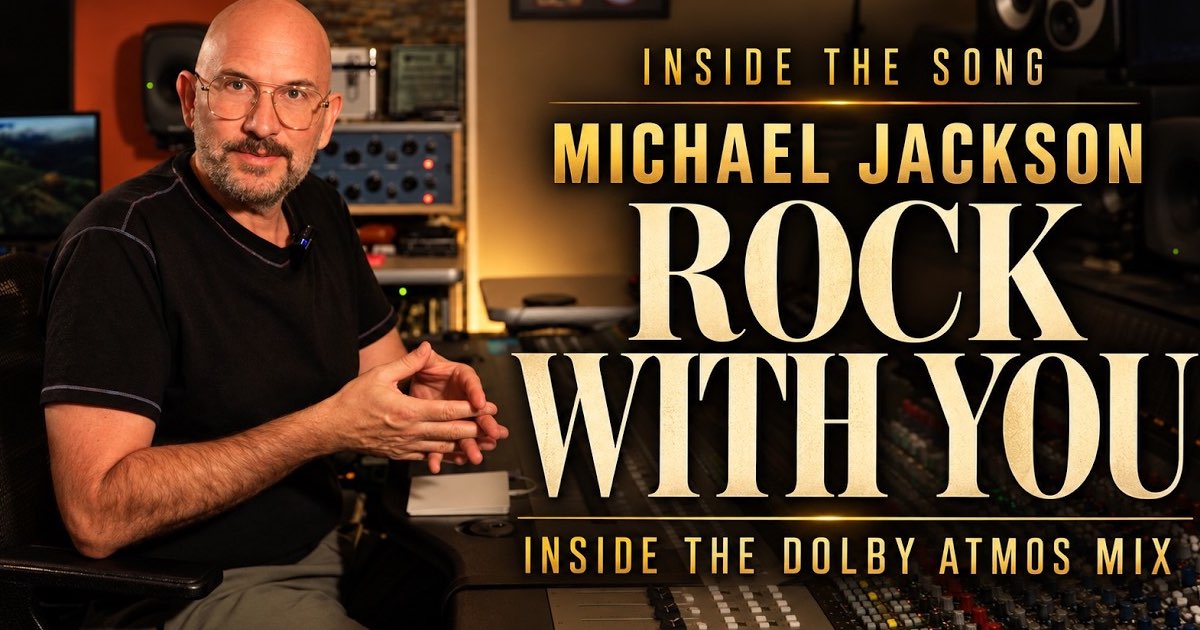
In “Rock with You” the electric guitars are an object a little behind you and almost on the floor, the Rhodes is wider at shoulder height, and Michael is in the center, with some of the center channel added to the phantom center we know from stereo. For the reverbs I built three instances on an Eventide H9000: a short one on the front wall, a longer one in the middle of the room and the longest, with more pre-delay, at the back. On speakers, or on a soundbar that projects to the walls and the ceiling, you hear Michael and then his trail traveling through the room. I go through it element by element in Inside “Rock with You”.
“I Can’t Help It”, the song Stevie Wonder wrote with Susaye Greene, has a flute line in the chorus that I placed slightly behind you and slightly above. Johnny Mandel’s muted strings are not very wide, so sending the flute back and up buys depth instead of width, and the two stop fighting over the same piece of the room. The harmony behind the song is in Inside “I Can’t Help It”.
Why it still sounds like Off the Wall
These are not new versions of the songs. Michael stays at the center of the front image, and his voice rules over any spatial trick. What Atmos adds is room to breathe, and a low end the record could not carry in 1979: everything was going to vinyl, and there was only so much bass and loudness a record could take. I am still conservative with it: I first mix the song the way it already is, and then send an extra 20% to the LFE. I never rely on the sub to carry a mix.
Instead of the usual 7.1.2 bed, I built the mixes as a bed of objects in 9.1.6, so they render natively on whatever plays them: AirPods, a soundbar, a 7.1.4 living room or a bigger room. On headphones, how close or far each element feels is set inside the mix with the Dolby Atmos binaural render mode. And making a song immersive does not mean things have to fly left and right. They can stay still and it still feels immersive, without losing the punch or the intimacy.
How to listen to Off the Wall in Dolby Atmos
- Apple Music with Spatial Audio. Look for the Dolby Atmos badge on the album page: it tells you that you are hearing the Atmos version and not the stereo one. Other services that support Dolby Atmos can carry the same mix.
- Headphones first. On an iPhone, go to Settings › Apps › Music › Dolby Atmos. With AirPods or Beats, “Automatic” is enough; with other headphones, choose “Always On”.
- Not on the phone speaker. It squeezes a lot of the work. If you only have the phone, use any headphones before the speaker.
- Offline. With “Download in Dolby Atmos” turned on in the Music settings, Apple Music subscribers can download the album in Atmos. It is not sold as a separate file, so “Off the Wall Dolby Atmos download” files on other sites are not the official mix.
Frequently asked questions
Is Michael Jackson’s Off the Wall available in Dolby Atmos?
Yes. Off the Wall has an official Dolby Atmos mix by Humberto Gatica and Carlos Rodgarman, made at RG Studio in Los Angeles for the Michael Jackson Estate and Sony Music / Epic Records, with immersive masters by Vlado Meller. It is released for streaming.
Who mixed Off the Wall in Dolby Atmos?
Humberto Gatica rebuilt the stereo from the original multitracks and Carlos Rodgarman built the Atmos mix at RG Studio, on a Neve Genesys G3D console and a Genelec 7.1.4 system.
When did Off the Wall come out in Dolby Atmos?
It was one of the first three albums of the project, together with Bad and Dangerous, released around the premiere of the biopic Michael in April 2026. HIStory and Invincible followed.
Does the Dolby Atmos version play at the same speed as the original?
Yes. The released 1979 record had been sped up in mastering, so it was slightly faster and higher than the multitrack tapes. The Atmos mix was matched to it section by section, so it plays at the same speed and pitch as the record everybody knows.
Can I download Off the Wall in Dolby Atmos?
Only inside the streaming service. Apple Music subscribers can download it for offline listening with “Download in Dolby Atmos” turned on. The Atmos version is not sold as a file, so downloads from other sites are not the official mix.
For the full story of the project, see the Michael Jackson in Dolby Atmos page, or read about another album of the series in Michael Jackson’s Dangerous in Dolby Atmos.